
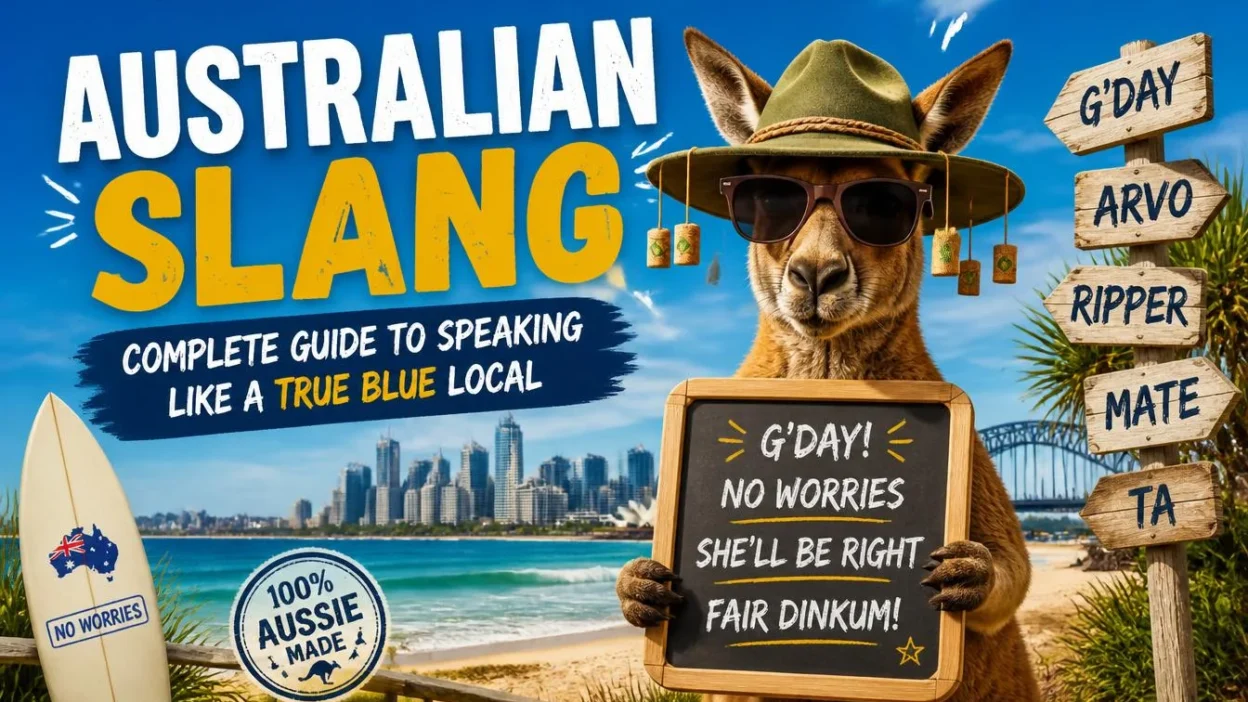
Have you ever heard someone say “G’day, mate!” and wondered if they were being friendly or just messing with you? Perhaps you heard “Yeah, nah” and had absolutely no idea if they meant yes or no. The Australian slang is one of the most distinctive and entertaining dialects in the English-speaking world, but it can be completely baffling to outsiders.
The Australian slang is more than just a collection of quirky words. It reflects the country’s laid-back culture, its love of humor, and its unique history. Australians have a well-earned reputation for shortening everything—afternoon becomes “arvo,” breakfast becomes “brekkie,” and McDonald’s becomes “Maccas” . In fact, Australia is the only country where McDonald’s has rebranded some of its signs to say “Maccas” because that’s what everyone calls it.
This comprehensive guide will take you through everything you need to know about Australian slang. We will cover essential greetings and everyday expressions, the best words to describe people and situations, colorful insults, and the regional variations that make Aussie slang so fascinating.
The Absolute Essentials: Greetings and Everyday Expressions
If you want to understand Australian slang, these are the words you’ll hear constantly. They are the foundation of everyday conversation.
G’day – The Classic Greeting
“G’day” is the quintessential Australian greeting. It simply means “hello” or “good day.” You’ll hear it everywhere, from the cities to the outback. Use it casually with anyone, and you’ll instantly sound more local.
How Ya Going? – The Friendly Check-In
“How ya going?” is the Aussie way of asking “How are you?” or “How’s it going?” . Don’t be confused—they’re not asking about your mode of transport. They genuinely want to know how you’re feeling.
Yeah, Nah – The Confusing Combo
This is one of the most confusing Australian slang phrases. “Yeah, nah” simply means no . It’s an Aussie way of softening a negative response. Someone might say “Yeah, nah, don’t think so” to politely decline an invitation.
No Worries / No Drama – The Aussie Motto
If there’s one phrase that captures the Australian spirit, it’s “no worries.” It means “no problem,” “forget about it,” or “I can do it.” “No dramas” and “she’ll be right” have similar meanings. “She’ll be right” is the ultimate expression of the Aussie laid-back attitude—everything will work out in the end .
Fair Dinkum – The Seal of Authenticity
“Fair dinkum” means genuine, true, or honest . If someone says “Is that fair dinkum?” they’re asking if you’re telling the truth. It’s a classic piece of Australian slang that has stood the test of time.
The Art of Shortening: Aussies Love Abbreviations
Australians have a legendary habit of shortening words and adding a vowel at the end. This is one of the most distinctive features of Australian slang .
Food and Drink
- Arvo: Afternoon
- Brekkie: Breakfast
- Cuppa: A cup of tea or coffee
- Maccas: McDonald’s
- Sanga: Sandwich
- Servo: Service or petrol station
- Snag: Sausage
- Stubbie: A short, squat beer bottle
People and Places
- Aussie: An Australian or Australia
- Battler: Someone who pushes through even when things are tough
- Sheila: A woman
- Tradie: A tradesperson
- Ute: A utility vehicle or pickup truck
- Yobbo: An uncouth or unruly person
Essential Phrases for Daily Life
Aussie Slang 101: At University
While at university, which is often shortened to “uni,” you might hear slang like:
- Tute: Short for tutorial
- Sesh: Short for session, used for studying or gym
- Bail: Refers to skipping something
- Bludge: To put in little or no effort
Out on the Town
Whether you’re at your local pub, a bar, or a nightclub, you might hear slang like:
- Flat white/mac/long black: Common coffee orders in Australia
- Parmi: A classic pub meal, though many states call it a “parma”
- Hot chips: French fries
- Sickie: A day off due to pretended illness
Funny and Quirky Australian Slang Phrases
Australian English has a lot in common with British English, and both often use somewhat unfiltered phrases that can be perceived as vulgar and offensive by non-native speakers .
- Flat out like a lizard drinking: Very busy
- All over the shop: Disorganised, chaotic
- Bonkers: Going beyond what is normal or conventional, very enthusiastic
- Brassed off: Fed up, annoyed
- Cactus: Broken, not working properly
- Chuck a wobbly: To throw a tantrum
- Chunder: To vomit
- Crack the sh*ts: To get really mad at a situation
- Dodgy: Suspicious, unreliable
- Dog’s breakfast: A mess, chaotic situation
- Far out: Expressing frustration at a situation
- Have a yarn: To have a chat or tell a story
- Hard yakka: Hard work or strenuous labor
- Put a sock in it: Be quiet
- Tell him he’s dreaming: Responding to an outrageous ask
- Woop woop: A remote or faraway place
Regional Differences
Like in many countries, Australian accents and slang can differ depending on where you live. For example, people from Queensland tend to be recognised for their elongated vowels, particularly with words featuring the double-O sound, such as ‘pool’, ‘school’ or ‘cool’ .
Similarly, you’ll find some slang differs across the country. For instance, ‘togs’, ‘cossies’ and ‘swimmers’ are all terms used for swimwear. Alternatively, ‘potato scallop’, ‘potato cake’ and ‘potato fritters’ are each used to describe a popular thinly sliced deep-fried potato snack, depending on where you are .
Queenslanders also have their own slang. Terms like ‘Brissie’, short for Brisbane, ‘the brown snake’, which means the Brisbane River, or ‘tallie’, which refers to a 750ml bottle of beer, are all popular in Queensland .
Frequently Asked Questions
What does “Aussie” mean in slang?
“Aussie” is the friendly slang term for an Australian person or Australia itself . The correct pronunciation is “O-zee” .
What does “yeah, nah” mean?
“Yeah, nah” simply means “no.” It is an Aussie way of softening a negative response .
What is the most common Australian slang word?
“No worries” is arguably the most common and captures the Australian spirit perfectly. It means “no problem” or “forget about it.”
What is a “battler” in Australian slang?
A “battler” is someone who pushes through even when things are tough. It describes a person with “few natural advantages, who works doggedly and with little reward, who struggles for a livelihood (and who displays courage in so doing)” .
What does “she’ll be right” mean?
“She’ll be right” is the ultimate expression of the Aussie laid-back attitude. It means everything will work out in the end .
What is “hard yakka”?
“Hard yakka” means hard work or strenuous labor. The word was first derived from “yaga,” which means “work” in the Yagara language .
Conclusion
The Australian slang is a vibrant and dynamic expression of the country’s identity. It is more than just a collection of words—it reflects the warmth, irreverence, and humor that define Australian culture. From the ubiquitous “G’day” to the confusing “yeah, nah,” every expression tells a story about the people who use it .
Understanding Australian slang is essential for truly connecting with Australians. It is the language of the streets, the pubs, and the friendships that define the country. Whether you are planning a trip Down Under, trying to understand an Australian TV show, or simply want to impress your friends, knowing your Aussie slang is the quickest way to sound like a local.
The next time someone invites you for a “cuppa” or asks if you want a “snag” on the “barbie,” you will know exactly what they mean. And if someone calls you a “drongo”? Just remember—as the Aussies say, “no worries, mate.”

I am Ethan Miles, a digital creator and caption enthusiast who loves turning simple moments into powerful words. I specialize in crafting creative, trendy, and engaging captions that help your posts stand out. At Captionestry, I focus on delivering fresh ideas, relatable expressions, and scroll-stopping content for every mood and moment. I’m passionate about social media culture, photography, and the art of storytelling through short, impactful lines.