
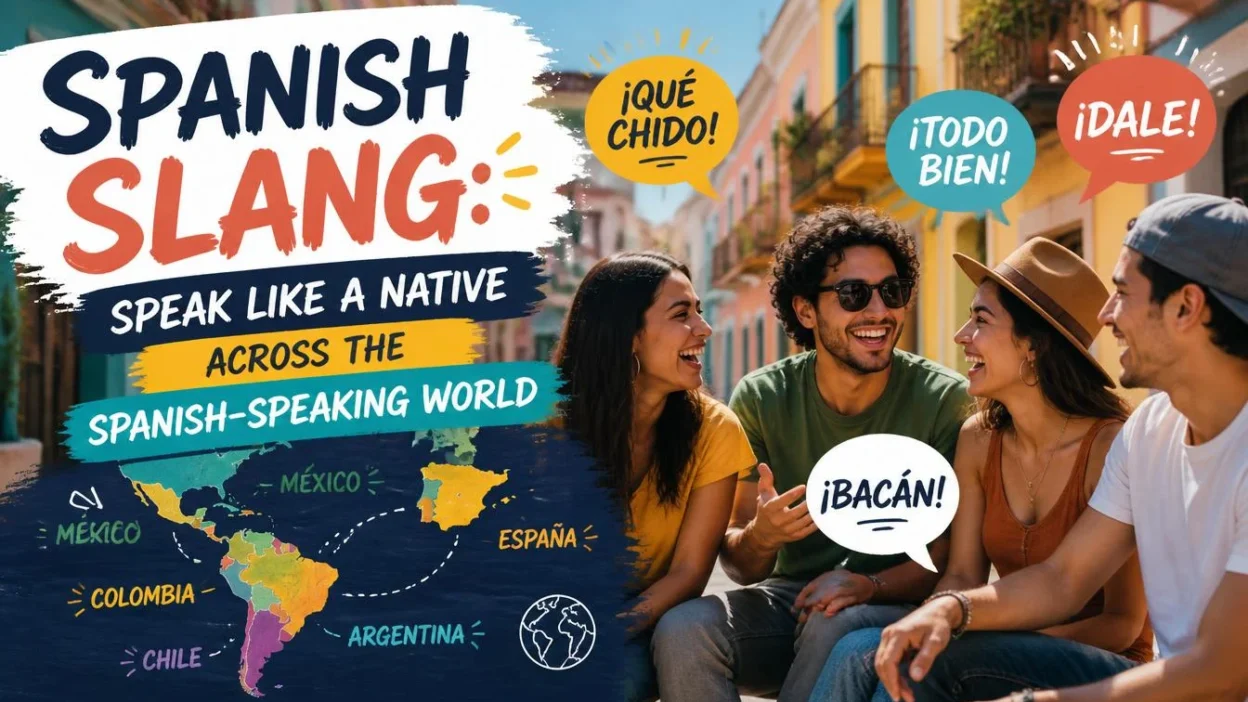
Have you ever learned Spanish in a classroom, only to visit Spain or Mexico and feel completely lost? Perhaps a Spanish friend called something “guay” or a Mexican friend said “¡Qué padre!” and you had no idea what they meant. The Spanish slang is one of the most colorful and diverse aspects of the language, varying dramatically across the 21 countries where Spanish is the official language.
The Spanish slang is more than just a collection of informal words—it is a window into the culture, humor, and identity of Spanish-speaking communities. Unlike textbook Spanish, slang is what you will hear on the streets, in markets, among friends, and in the music and movies that define each country. From the “tío” and “guay” of Spain to the “chévere” and “vaina” of Latin America, each region has its own flavor of slang that gives the language its soul.
This comprehensive guide will take you through everything you need to know about Spanish slang. We will cover essential words from Spain, Mexico, Argentina, Colombia, and other Latin American countries. We will also provide crucial warnings about regional differences—what means “cool” in one country might mean something completely different and offensive in another.
Spain Spanish Slang
Spain uses its own unique set of slang terms that differ significantly from Latin American Spanish. Here are the most common ones you need to know.
Guay
This is the quintessential Spanish word for “cool.” A Spanish speaker may use this word to describe someone or something they find attractive or likeable . They also use it as an exclamation of approval, similar to saying “Cool!” or “Awesome!”
Examples:
- “¡Qué guay!” – “How cool!”
- “Esa camiseta es muy guay” – “That shirt is very cool”
Tío / Tía
Literally meaning “uncle” and “aunt,” Spaniards use these words to mean “dude,” “guy,” or “mate” . They are the Spanish equivalent of calling someone “bro” or “man” in English.
Examples:
- “¡Oye, tío!” – “Hey, dude!”
- “¿Qué pasa, tía?” – “What’s up, girl?”
Vale
Spaniards use “vale” constantly. It means “OK,” “alright,” or “got it.” You will hear it in every conversation as a filler word .
Examples:
- “Vale, nos vemos mañana” – “OK, see you tomorrow”
- “¿Vale?” – “Alright?”
Mola / Molar
“Molar” is another Spanish slang term similar to “guay.” It means “cool” or “awesome.” You might say “Me mola” to mean “I like it” .
Examples:
- “Eso mola mucho” – “That’s very cool”
- “¿Te mola la idea?” – “Do you like the idea?”
Pasta
In Spain, “pasta” means money . It is the equivalent of saying “cash” or “dough” in English.
Example:
- “No tengo pasta para ir al cine” – “I don’t have money to go to the movies”
Currar
This means “to work.” It is the casual way to talk about your job.
Example:
- “Estoy currando mucho esta semana” – “I’m working a lot this week”
Joder
This is a common Spanish exclamation expressing frustration, surprise, or annoyance. It is similar to saying “damn” or “shit” in English. Use it with caution—it is quite strong.
Cómo Mola
Another way to say “how cool” or “how awesome.” It is used to express excitement about something.
Me da igual
This means “I don’t care” or “it’s all the same to me.” It is a useful phrase for expressing indifference.
Mexican Spanish Slang
Mexico has one of the richest and most famous slang vocabularies in the Spanish-speaking world.
Güey (or Wey)
Pronounced like “way,” this is the most ubiquitous word in Mexican slang. It can mean “dude,” “bro,” “mate,” or even “guy.” The tone determines whether it’s friendly or insulting.
Example: “Oye, güey, ¿ya viste la hora?” – “Hey dude, have you seen the time?”
¿Qué onda?
This is the quintessential Mexican greeting among friends. It means “What’s up?” or “What’s the vibe?” Literally, it translates to “What wave?”
Example: “¿Qué onda, güey?” – “What’s up, dude?”
Chido / Padre
These are your go-to words for expressing approval or admiration. They mean “cool,” “awesome,” “great,” or “fantastic.” “Padre” literally means “father,” but in slang, its meaning completely changes.
Example: “¡Qué padre está tu coche!” – “Your car is so cool!”
Example: “La película de anoche estuvo muy chida” – “Last night’s movie was really cool”
Neta
This is a cornerstone of informal Mexican conversation, used to question or affirm sincerity. It means “Really?” “For real?” or “The truth.”
No Manches
This expresses surprise, disbelief, or frustration. It is the slightly politer cousin of “no mames.” It means “No way!” or “You’re kidding!”
Example: “Subieron el precio de los tacos otra vez. ¡No manches!” – “They raised the price of tacos again. Come on!”
Órale
This is one of the most versatile Mexican slang words. It can mean “Let’s go,” “OK,” “Wow!,” or “Sounds great!” depending on the tone.
Example: “¿Quieres ir?” “Órale, vamos!” – “Do you want to go? OK, let’s go!”
Pinche
This is an intensifier meaning “goddamn” or “fucking.” Use it to emphasize frustration with a person or situation.
Example: “¿Dónde está el pinche coche?” – “Where’s the goddamn car?”
Lana
Literally “wool,” this is the most common slang term for money in Mexico.
Example: “No tengo lana” – “I don’t have any money”
Chamba
This means work or a job.
Example: “Tengo mucha chamba hoy” – “I have a lot of work today”
Fresa
Literally “strawberry,” but used to describe someone who is snobby or preppy.
Naco
Used to describe someone who has money but no class, or simply someone with no class.
Carnal
This means “brother” or “close friend.”
Argentine Spanish Slang (Lunfardo)
Argentina has its own unique slang called “Lunfardo.” The accent and vocabulary are very different from other Spanish-speaking countries.
Che
This is the most famous Argentine slang word. It means “hey” or “dude” and is used to get someone’s attention.
Example: “Che, ¿cómo estás?” – “Hey, how are you?”
Boludo
This literally means “big balls.” It is used as a term of endearment or insult depending on the tone. Among friends, it means “dude.” As an insult, it means “idiot.”
Copado
This means “cool” or “awesome.” It is the Argentine equivalent of “guay” or “chido.”
Example: “Esa película está copada” – “That movie is cool”
Pibe
This means “kid” or “boy.” It is used to refer to a young person.
Example: “Los pibes están jugando al fútbol” – “The kids are playing soccer”
Mina
This is Argentine slang for “girl” or “woman.”
Bondi
This means “bus.” You won’t hear this word anywhere else.
Example: “Voy a tomar el bondi” – “I’m going to take the bus”
Fiaca
This means “laziness” or “being lazy.”
Laburo
This means “work” or “job.” The verb is “laburar.”
Example: “Estoy buscando laburo” – “I’m looking for work”
Ñoqui
Literally “gnocchi,” but used in Argentina to mean someone who has a government job but does nothing. It refers to how people would eat gnocchi on the 29th of the month when they got their paycheck.
Colombian Spanish Slang
Colombia has its own colorful slang that is widely recognized across Latin America.
Parce / Parcero
This means “friend” or “buddy.” It is one of the most common words in Colombian Spanish.
Example: “¿Qué más, parce?” – “What’s up, buddy?”
Qué más?
This is the Colombian way of saying “What’s up?” or “How are you?”
Chévere
This means “cool,” “great,” or “awesome.” It is widely used across Colombia and other Latin American countries.
Example: “Esa música está chévere” – “That music is cool”
Vaina
This is a versatile word that can mean “thing,” “situation,” or “problem.” It is similar to the English word “thing” when used vaguely.
Example: “Esa vaina no funciona” – “That thing doesn’t work”
Pola
This is Colombian slang for “beer.”
Example: “Vamos por unas polas” – “Let’s go get some beers”
Bacano
Another word for “cool” or “awesome.”
Example: “Qué bacano que viniste” – “How cool that you came”
Rumba
This means “party” or “dancing.” The verb is “rumbear,” meaning to party.
Example: “Vamos de rumba” – “Let’s go party”
¿Qué hubo?
This means “What’s up?” and is used as a casual greeting.
Regional Warnings: Words That Mean Different Things
One of the most important things about Spanish slang is that the same word can mean completely different things in different countries. Here are some crucial examples.
Coger
- Spain: To grab or to take
- Mexico, Argentina, and many Latin American countries: A vulgar word meaning “to f***”
Warning: Never say “Voy a coger un taxi” in Mexico. It means “I’m going to f*** a taxi.”
Pico
- Chile: A small amount or a peak
- Spain: A kiss (in some contexts)
- Mexico: A cursed word for “penis” (¡Pico! is like “Damn it!”)
Warning: Use this word with extreme caution. In Mexico, ¡Pico! means “Pen*s!”
Torta
- Mexico: A sandwich
- Spain: A slap or a type of cake
- Argentina/Chile: A derogatory word for lesbian
- Internet Slang: An person Latina woman (body shaming)
Warning: Never use “torta” casually without knowing where you are.
Concha
- Argentina: A type of pastry
- Mexico: A shell
- South America: A vulgar word for “vagina”
Warning: Never use “concha” casually in South America.
Bicho
- Spain: A bug or insect
- Puerto Rico: A curse word for “penis”
Warning: “Bicho” in Spain is neutral. In Puerto Rico, it’s offensive.
Culo
- Spain: A vulgar word for “a**”
- Colombia/Venezuela: A person’s behind (less vulgar but still informal)
Warning: The meaning is similar, but the severity differs dramatically.
Chavo
- Mexico: A child or young person
- Spain: Money
- Venezuela: A young person or guy
Warning: “Chavo” in Spain means money. In Mexico, it means a kid.
Guagua
- Cuba and Caribbean: A bus
- Chile and Andes: A baby
Warning: “Guagua” means bus in Cuba, baby in Chile.
Chucha
- Colombia: A term of surprise or shock
- Chile: A vulgar word for “vagina”
Warning: “¡Chucha!” in Colombia means “Wow!” In Chile, it’s highly offensive.
Pendejo
- Mexico/Colombia: A dummy or a coward
- South America: A minor boy or a pube (the hair)
- Spain: A pubic hair
Warning: “Pendejo” means idiot in Mexico, but a pubic hair in Spain.
Concha de tu madre
- Argentina: A heavy swear word (literally “your mother’s vagina”)
- Other countries: Also offensive, but less so
Warning: This is a major insult in Argentina, but in Mexico, “concha” is just a shell.
Frequently Asked Questions
What does “guay” mean in Spanish slang?
“Guay” means “cool” or “awesome.” It is used primarily in Spain.
What does “chido” mean in Mexican slang?
“Chido” means “cool” or “awesome.” It is one of the most common Mexican slang words.
What does “chévere” mean?
“Chévere” means “cool,” “great,” or “awesome.” It is used in Colombia and other Latin American countries.
What does “güey” mean?
“Güey” (or “wey”) is Mexican slang for “dude,” “bro,” or “mate.” It is extremely common.
What does “qué onda” mean?
“¿Qué onda?” is a Mexican greeting meaning “What’s up?” or “What’s the vibe?”
What does “boludo” mean in Argentina?
“Boludo” means “dude” among friends but can mean “idiot” as an insult. It depends on the tone.
What is the most important warning about Spanish slang?
The same word can mean completely different things in different countries. “Coger,” “pico,” “torta,” “concha,” and many others have drastically different meanings depending on where you are.
Conclusion
The Spanish slang is a vibrant, dynamic expression of the culture and identity of the Spanish-speaking world. From the “guay” of Spain to the “chévere” of Colombia, each country has its own unique flavor of slang that gives the language its soul.
Understanding the Spanish slang is essential for truly connecting with Spanish speakers. It is the language of the streets, the markets, and the friendships that define each culture. However, the most important rule is this: context is everything. A word that means “cool” in one country can mean something completely offensive in another.
The next time you travel to a Spanish-speaking country, pay attention to what locals say. And before you use a slang word, make sure you know exactly what it means where you are. Because in the world of Spanish slang, a compliment in one country might be a curse in the next.

I am Ethan Miles, a digital creator and caption enthusiast who loves turning simple moments into powerful words. I specialize in crafting creative, trendy, and engaging captions that help your posts stand out. At Captionestry, I focus on delivering fresh ideas, relatable expressions, and scroll-stopping content for every mood and moment. I’m passionate about social media culture, photography, and the art of storytelling through short, impactful lines.