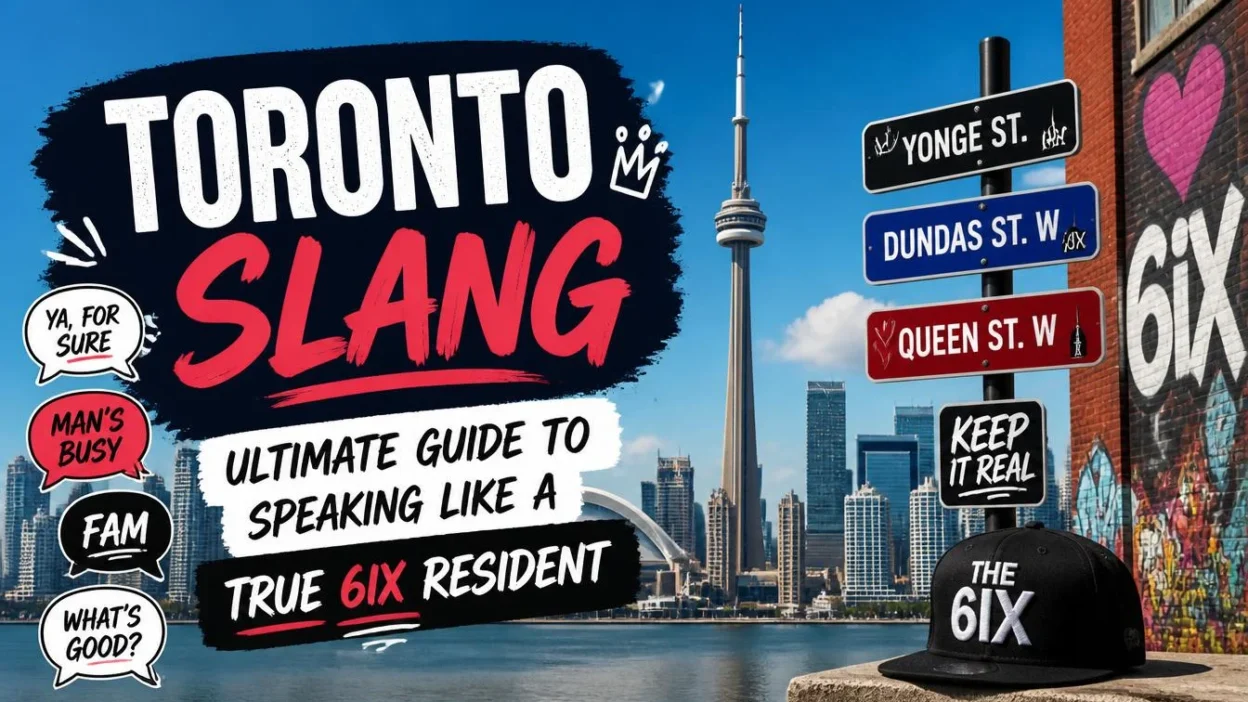
Have you ever heard someone say “Wagwan, fam?” and wondered if they were speaking a different language? Perhaps you visited Toronto and heard locals say “That’s bare mazza, ahlie?” and felt completely lost. The Toronto slang is one of the most unique and vibrant dialects in North America. The city’s incredible diversity and multicultural influences have shaped this distinct way of speaking.
Toronto slang, which linguists call Multicultural Toronto English (MTE) , draws from Caribbean Patois, Somali, Arabic, and British English . The city’s streets, schools, and global pop culture presence all feature this dialect. This isn’t just a few quirky words—it’s a living language. The city’s immigrant communities created it, and its youth spread it across the world.
This comprehensive guide will take you through everything you need to know about Toronto slang. We will cover the essential greetings, the most common expressions to describe things and people, where this language comes from, and the controversies that have arisen when outsiders get it wrong.
What is Toronto Slang? The Multicultural Toronto English
The Toronto slang is more than just a collection of words. It is a linguistic phenomenon with deep roots.
The Core Definition: A Cultural Dialect
Toronto slang is a unique dialect. The city’s diverse communities, especially its Black, Caribbean, and Somali populations, have primarily shaped it. Jamaican Patois, Arabic, Somali, and British slang mix together and adapt to become its own distinct way of speaking .
University of Toronto linguist Derek Denis coined the term “Multicultural Toronto English” (MTE) to describe this phenomenon . This represents an example of “transcultural diffusion,” where language spreads and evolves across different cultural groups . This is not just “Ebonics” or “slang” in a traditional sense. It is a fully formed dialect with its own vocabulary, rhythm, and grammatical rules.
Why Is It So Unique?
The Toronto slang is unique because it reflects the city’s population. Unlike other North American cities, Toronto has a massive and influential Caribbean and African diaspora. Words from Jamaican Patois like “wagwan” and “ahlie” have become mainstream. Arabic and Somali words like “miskeen,” “khalas,” and “wallahi” are now part of everyday speech among young people from all backgrounds .
However, a very important debate surrounds this language. Much of the slang has roots in specific communities, particularly Black Torontonians. When someone from outside those communities (like an actor from Oakville) uses it for entertainment, locals often see this as gentrification or mockery rather than appreciation . This highlights a sensitive topic about who “owns” the culture behind the language.
The Most Essential Toronto Slang Words
The Toronto slang has a vocabulary for almost every situation. Here are the most essential words and phrases you need to know.
Greetings and Positivity
- Wagwan: This serves as the classic greeting. It comes from Jamaican Patois and simply means “What’s going on?” or “What’s happening?”
- Ahlie: People use this for affirmation or agreement. They often put it at the end of a sentence to ask “Am I right?” or “Don’t you agree?” For example, “This weather is confused, ahlie?”
- Yallah / Chalo: Both of these mean “Let’s go” or “Hurry up.” “Yallah” comes from Arabic, and “Chalo” comes from Hindi, Urdu, and Punjabi.
- Blessed: This asks if someone is okay or doing well. “Are you blessed, fam?” basically means “Are you good, my friend?”
Describing Things (Positive & Negative)
- Bare: This means “many” or “a lot.” If there are “bare people” at a party, it’s packed.
- Marved: This derives from “starved” and means you are extremely hungry.
- Mazza: People use this to describe something that is “madness” or incredibly fun or confused. “That song is real mazza!” means that song is amazing or impulsive.
- Cheesed: If you are “cheesed,” you feel annoyed, upset, or angry. It means “pissed off.”
- Gassed: This represents the opposite of cheesed. If you are “gassed,” you feel excited, hyped, or happy.
- Chopped / Murked / Dess: All of these insults mean “ugly” or unattractive. If someone says you are “chopped” or “murked,” they are calling you ugly.
- Dutty: This comes from Jamaican Patois and means “gross,” “dirty,” or “shady.” If someone does something “dutty,” they did something icky or untrustworthy.
People and Actions
- Crodie: This popular term means a close or trustworthy friend. Drake and Bruno Mars have used it, putting a spotlight on Toronto slang.
- Bredrin / Fam: Both mean “brother,” “good friend,” or “homie.” They indicate closeness.
- Reach: This means to arrive or meet somewhere. “I’ll reach you later” means “I’ll meet up with you later.”
- Two-twos: This means “quickly,” “in a jiffy,” or “in conclusion.” It comes from the idea of putting “2 and 2 together.”
- Wallahi: This means “I swear to God” and people use it to make a promise or emphasize truth. It comes from Arabic and Somali.
The Origins of Toronto Slang
The Toronto slang has deep roots in the city’s immigrant communities.
Roots in Caribbean and African Communities
The Toronto slang is a direct result of immigration. The city saw significant waves of immigration from the Caribbean, East Africa, and the Middle East in the late 20th and early 21st centuries. These communities brought their languages with them. Their younger generations created a new, blended way of speaking.
Words like “wagwan,” “ahlie,” “bredrin,” and “dutty” come directly from Jamaican Patois. “Miskeen,” “khalas,” and “wallahi” come from Arabic and Somali. This phenomenon did not happen overnight. It is the result of generations of cultural exchange in a city that stands as one of the most diverse in the world.
The Linguistic Terms You Should Know
- Multicultural Toronto English (MTE): U of T linguist Derek Denis coined this academic term for the dialect.
- Transcultural Diffusion: This describes the process by which words and phrases from different cultures spread and become shared across a population.
The Controversies: When Slang Goes Mainstream
The Toronto slang has become a topic of heated debate, especially when it leaves the communities that created it.
The Jimmy Fallon Incident
In March 2026, actress Camila Morrone appeared on The Tonight Show and quizzed Jimmy Fallon on Toronto slang. She had learned the words from her co-star, Adam DiMarco. The problem: DiMarco came from Oakville, a suburb far from Toronto, and not actually part of the communities that speak this dialect.
The segment went viral, but for the wrong reasons. Many locals felt furious, accusing the actors of gentrifying and mocking a culture they didn’t understand. The phrases they used, like “two two’s my word, croski” and “that’s too mazza, ahlie,” seemed like a parody of a dialect that has deep cultural significance for Black and immigrant communities. This incident exposed the fine line between appreciating a culture and stealing from it.
Bruno Mars and the “Crodie” Trend
When Bruno Mars used the slang term “crodie” during a concert in Toronto in May 2026, the reaction was much more positive. “Crodie” means a trustworthy friend, and the crowd went wild. The audience saw this as a genuine sign of respect for the city and its culture. The key difference appeared to be context and intent: Mars respected the culture, while the Fallon segment turned the language into a punchline.
Frequently Asked Questions
What does “Toronto mans” mean?
“Toronto mans” is a playful, self-referential term that describes people who embody the city’s slang and culture. Memes and online discussions about Toronto often feature this phrase.
What is a “two-four” in Toronto?
A “two-four” refers to a case of 24 beers. It is a common term across Canada.
Why is Toronto called “The 6ix”?
Drake popularized this nickname. It refers to the six former cities that merged to form the current city of Toronto in 1998.
What does “say word?” mean?
It means “really?” or “are you serious?” People use it to express surprise or disbelief at something someone just said.
Conclusion
The Toronto slang is a vibrant and dynamic expression of the city’s identity. This language tells the story of its people, building from the words of Caribbean, African, and Middle Eastern immigrants and spreading through its youth. People both love and debate this dialect, celebrating its creativity and criticizing its appropriation.
Understanding the Toronto slang is more than just learning a few phrases. It is about understanding the city itself. To speak like a Torontonian is to acknowledge the contributions of the diverse communities that built the city. Whether you are “reaching” a friend, saying “wallaahi” to make a promise, or describing something as “bare mazza,” you are participating in a living, breathing piece of Toronto’s culture.
I am Ethan Miles, a digital creator and caption enthusiast who loves turning simple moments into powerful words. I specialize in crafting creative, trendy, and engaging captions that help your posts stand out. At Captionestry, I focus on delivering fresh ideas, relatable expressions, and scroll-stopping content for every mood and moment. I’m passionate about social media culture, photography, and the art of storytelling through short, impactful lines.