The real challenge is knowing how to make a short line work. Good captions often create a quick connection between the image and the reader. They can use wordplay, irony, awkward situations, or everyday humor. This guide explains how the contest works, what makes a caption effective, and how you can develop better ideas before submitting your entry.
What Is the New Yorker Cartoon Caption Contest?
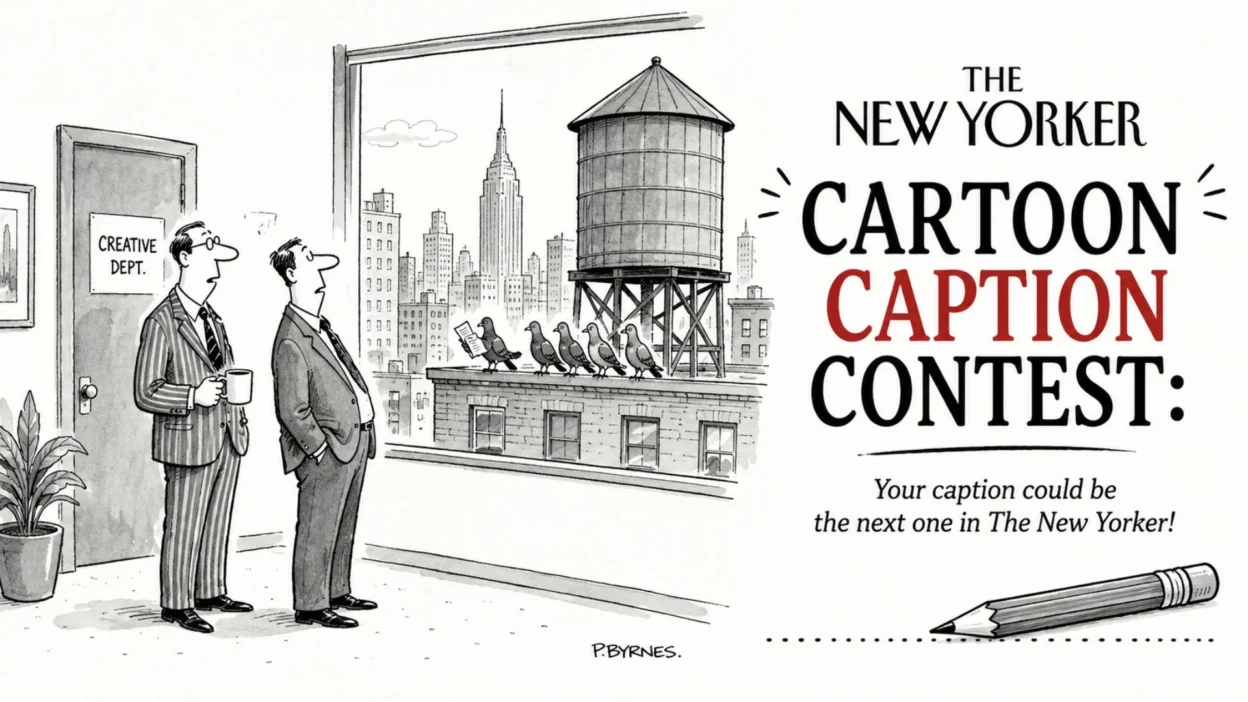
The contest is a creative writing challenge connected with The New Yorker’s cartoon tradition. Participants create captions for a featured cartoon and compete by submitting their funniest ideas.
A good entry usually has three qualities:
- It fits the visual situation without simply describing it. 👀
- It creates an unexpected punchline. 💡
- It feels short enough to work naturally with the cartoon. ✍️
Why Is the Caption Contest So Challenging?
Writing a short joke can be harder than writing a long paragraph. You have limited space, so every word needs to contribute something.
The Image Already Tells a Story
The cartoon gives you characters, expressions, objects, and context. Your caption should add something rather than repeat what the reader can already see.
Humor Depends on Timing
A strong caption often delays the obvious interpretation and then changes the meaning with a final phrase.
Small Details Can Create Big Jokes
Look closely at clothing, body language, surroundings, signs, furniture, and character relationships. A tiny visual detail can become the center of a great caption.
How to Study a Cartoon Before Writing
Spend a little time examining the image before creating captions. Instead of writing the first joke that comes to mind, explore several possible interpretations.
- Ask what each character might secretly be thinking. 🤔
- Look for something unusual in the background. 🔎
- Imagine what happened immediately before the scene. 🎬
- Imagine what could happen immediately afterward. 🚪
- Find the most awkward element in the picture. 😅
- Think about how two characters might misunderstand each other. 🗣️
- Look for a detail that could have a completely different meaning. 🧩
Caption Ideas for a New Yorker-Style Cartoon
These examples show the kinds of short, observational approaches that can work for cartoon humor. They are original examples rather than entries from an actual contest.
- “Well, that explains the meeting invitation.” 📩
- “I thought you said this was casual.” 👔
- “Nobody mentioned the second meeting.” 😐
- “Let’s pretend we planned this.” 🎭
- “I have several questions.” ❓
- “This wasn’t in the brochure.” 📖
- “Perhaps we should start over.” 🔄
- “You said it would be simple.” 🫠
- “I knew there was a catch.” 🎣
- “Let’s never discuss this again.” 🤐
Funny Caption Writing Techniques
Different humor techniques can produce very different results. Experimenting with several approaches helps you avoid predictable jokes.
Use Misunderstanding
A character may interpret a situation differently from everyone else.
- “That’s not what I meant by flexible.” 🌀
- “We clearly have different definitions.” 📚
- “Apparently, I missed an important email.” 📧
Use Understatement
Sometimes the funniest response is surprisingly calm.
- “This could have gone better.” 😌
- “Slightly unexpected.” 👀
- “Not ideal.” 🙃
Use Wordplay
A clever double meaning can make a short caption memorable.
- “I suppose that’s one way to look at it.” 🔄
- “Things are becoming complicated.” 🧠
- “That’s a rather specific problem.” 🎯
Use Awkward Dialogue
Imagine the characters have just said something embarrassing or unexpected.
- “You weren’t supposed to say that out loud.” 😳
- “Can we discuss this somewhere else?” 🚶
- “I was hoping you’d forget.” 🫣
How to Make a Cartoon Caption Funnier
The strongest idea is not always the funniest final caption. Editing can turn an average joke into a cleaner and more effective line.
- Remove words that do not add to the joke. ✂️
- Replace long phrases with shorter ones. ⚡
- Move the funniest word toward the end. 🎯
- Avoid explaining why the joke is funny. 🤫
- Read the caption aloud to test its rhythm. 🎙️
- Write several versions before choosing one. 📝
- Keep the visual context in mind while editing. 🖼️
Common Caption Mistakes
Many captions fail because they explain the picture instead of adding a new layer of humor. A few simple changes can make your writing much stronger.
- Do not describe exactly what the reader can already see. 🚫
- Do not pack too many ideas into one caption. 🧱
- Do not force a complicated pun into every joke. 🧩
- Do not make the caption longer than necessary. ✂️
- Do not rely only on obvious punchlines. 💭
- Do not ignore the characters’ expressions and relationships. 👥
A Simple Process for Creating Better Captions
You can use a repeatable process whenever you face a new cartoon. The goal is to generate many possibilities before choosing the strongest one.
Start With Observation
Write down everything unusual about the image without trying to be funny yet.
Create Different Interpretations
Imagine the same scene as a workplace problem, family conversation, social misunderstanding, or completely absurd situation.
Generate Multiple Punchlines
Write several short options. Some will be weak, and that is normal. The process helps reveal stronger ideas.
Edit Ruthlessly
Remove unnecessary words. Keep the version that creates the clearest and quickest reaction.
Frequently Asked Questions About the New Yorker Cartoon Caption Contest
What is the New Yorker Cartoon Caption Contest?
It is a caption-writing challenge associated with The New Yorker’s cartoon tradition, where participants create humorous captions for a featured cartoon.
How do I write a good cartoon caption?
Study the image carefully, identify an unusual detail, explore different interpretations, and create a short punchline that adds something new.
Does a caption need to describe the cartoon?
Not necessarily. In many cases, a caption is more effective when it adds an unexpected interpretation rather than describing the obvious action.
Should cartoon captions be short?
Short captions often work well because they are easy to read and allow the visual joke to remain important.
Can wordplay work in a cartoon caption?
Yes. Wordplay can be effective when it feels natural and connects clearly with something in the image.
Should I write several captions?
Creating multiple versions can help. Your first idea may not be your strongest one, so experimentation gives you more choices.
What makes a caption memorable?
A memorable caption often combines brevity, surprise, relevance to the image, and a clear humorous idea.
Can beginners enter a cartoon caption contest?
Creative caption writing does not require professional comedy experience. Beginners can practice by studying cartoons and developing multiple interpretations.
How can I improve my caption-writing skills?
Read and study different forms of humor, observe everyday situations, practice concise writing, and experiment with different punchline styles.
Is describing the cartoon a good strategy?
Usually, description alone adds little because readers can already see the image. A stronger caption often provides an unexpected thought, reaction, or interpretation.
Conclusion
The New Yorker Cartoon Caption Contest is a great exercise in concise humor and creative observation. The image gives you the setup, but your words can introduce an entirely different interpretation. That is where the real challenge begins.
Start by studying every detail of the cartoon. Then consider different characters, situations, misunderstandings, and possible punchlines. Write several ideas instead of stopping at the first one. Afterward, remove unnecessary words and keep the version that feels the cleanest.
You do not need an elaborate joke to create an effective caption. Sometimes a simple sentence, placed at exactly the right moment, can completely change how someone sees the cartoon. Practice, observation, and careful editing can make your captions sharper over time.

I am Ethan Miles, a digital creator and caption enthusiast who loves turning simple moments into powerful words. I specialize in crafting creative, trendy, and engaging captions that help your posts stand out. At Captionestry, I focus on delivering fresh ideas, relatable expressions, and scroll-stopping content for every mood and moment. I’m passionate about social media culture, photography, and the art of storytelling through short, impactful lines.