
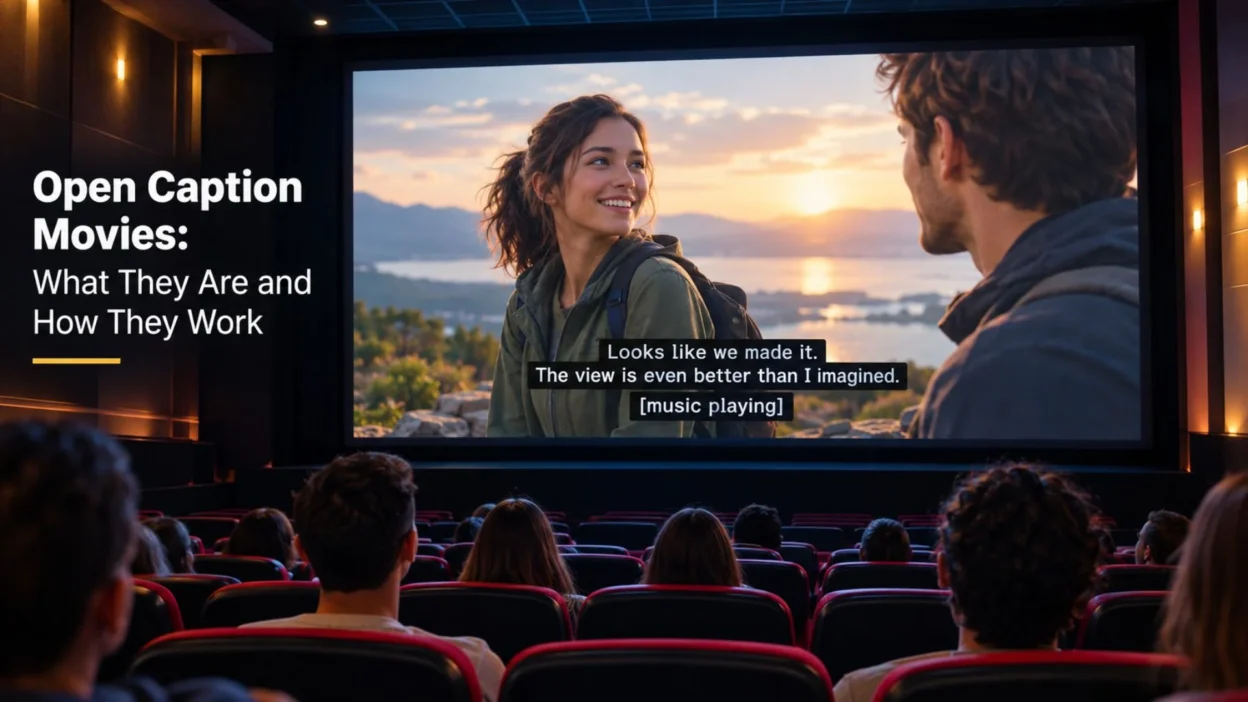
Open captions display spoken dialogue as text directly on the movie screen. Unlike closed captions, they are visible to everyone in the theater and do not need to be switched on.
For viewers who are deaf or hard of hearing, open captions can make dialogue easier to follow. They can also help people watching movies in noisy environments or anyone who simply prefers reading along with the dialogue.
This guide explains what open captions mean, how they work in theaters, how they compare with subtitles and closed captions, and what you can expect when you attend an open-caption screening.
What Are Open Caption Movies?
Open caption movies are films presented with captions permanently visible on the screen during the movie.
The captions usually appear near the bottom of the screen and provide the spoken dialogue in written form. Depending on the captioning format, they may also identify important sounds or other audio information.
The key feature is simple: the captions are part of the movie presentation and are visible to everyone watching.
This makes open caption screenings different from systems where individual viewers can turn captions on or off.
For example, an open-caption version might display dialogue such as:
Maya: Are you ready to go?
The text remains visible as part of the screening. Every person in the auditorium sees the same captioned presentation.
How Do Open Captions Work?
Open captions are included directly in the movie’s visual presentation.
When the film is prepared for an open-caption screening, the caption text is synchronized with the dialogue and appears on the screen at the appropriate moment.
Viewers do not need special equipment to read the captions. There is also no separate caption device attached to the theater seat.
This creates a straightforward viewing experience:
- The movie plays normally with captions displayed on screen. 🎬
- Dialogue appears as text when characters speak. 💬
- Everyone in the auditorium sees the captions. 👀
- No individual caption device is required. 🍿
Because the captions are visible to the entire audience, open captioning can be especially useful when accessibility is a priority.
Why Do Theaters Offer Open Caption Screenings?
Open-caption screenings give theaters a way to make movies more accessible to a wider range of viewers.
A person who has difficulty hearing dialogue may find it much easier to follow a movie when the words are displayed clearly on screen.
Captions can also be helpful when a film contains:
- Fast dialogue
- Quiet conversations
- Strong accents
- Unfamiliar names
- Important background sounds
- Scenes where characters speak softly
The goal is not to change the movie. Instead, captions provide another way for viewers to receive information that would otherwise come through the soundtrack.
Who Can Benefit From Open Captions?
Open captions can be useful for many different viewers.
They are particularly valuable for people who are deaf or hard of hearing. However, accessibility is not the only reason someone might prefer them.
People who are learning English may also find captions helpful because they can connect spoken words with their written form.
Some viewers simply understand dialogue better when they can read it.
Open captions may benefit:
- Deaf viewers who rely on written dialogue. 🧏
- Hard- partially deaf viewers who want additional dialogue support. 👂
- People learning or practicing a language. 📚
- Viewers who have difficulty understanding quiet dialogue. 🎧
- People watching movies with unfamiliar accents. 🌎
- Anyone who prefers reading dialogue while watching. 📖
The important point is that there is no single type of person who can use an open-caption screening.
Are Open Captions Always Visible?
Yes. That is one of the main characteristics of open captioning.
The captions are displayed as part of the movie presentation, so viewers cannot individually turn them off.
This is different from closed captions, which are generally designed to be enabled or disabled depending on the viewer’s needs and the available playback system.
If you attend an open-caption screening, you should expect the caption text to remain on the screen throughout the relevant portions of the film.
That difference matters in theaters.
An open-caption screening does not require every viewer to have a personal captioning device. Instead, the caption text is displayed directly on the shared screen.
Closed captions are more flexible for individual viewing because a person can choose whether to use them when the playback system supports that option.
In simple terms:
- Open captions: visible to the entire audience. 👥
- Closed captions: generally controlled by the viewer or playback system. 🎛️
- Open-caption theater screening: captions appear directly on the movie screen. 🎞️
- Closed-caption system: captions may require compatible equipment or settings. ⚙️
Open Captions vs. Subtitles
The terms “captions” and “subtitles” are sometimes used interchangeably, but they can serve slightly different purposes.
Subtitles generally focus on spoken dialogue. They are commonly used to help viewers understand dialogue in another language.
Captions can provide dialogue plus additional information about important audio.
For example, a caption track may indicate that:
[doorbell rings]
or
[dramatic music playing]
This type of information can be useful because it communicates something that viewers might otherwise miss from the soundtrack.
However, the exact information included can vary depending on how the movie’s caption track was created.
Do Open Captions Include Sound Effects?
They can.
Captioning may include important non-dialogue sounds when those sounds help communicate what is happening in the scene.
Examples can include:
- [phone ringing] 📱
- [door closes] 🚪
- [applause] 👏
- [music playing] 🎵
- [thunder] ⛈️
- [laughter] 😄
The purpose is to communicate meaningful audio information through text.
However, not every captioned movie will describe every sound. The amount of sound information depends on the caption track and how it was produced.
What Do Open Captions Look Like?
Most open captions appear as readable text near the bottom of the movie screen.
The exact appearance can vary. Caption designers consider factors such as readability, timing, screen placement, and the visual content of the scene.
Captions generally need to be easy to distinguish from the movie itself.
You may see dialogue presented in a format that identifies the speaker when necessary. Sound descriptions may also appear in brackets.
For example:
Alex: We should leave now.
Or:
[car engine starts]
The presentation can vary between films and captioning systems.
Do Open Caption Movies Change the Film?
No. Open captions do not normally change the movie’s story, performances, or scenes.
They add written information to the visual presentation.
The original audio remains part of the movie. Viewers who can hear the soundtrack can continue listening normally, while viewers who benefit from text have an additional way to follow the content.
Think of open captions as an accessibility layer added to the viewing experience.
The movie itself remains the same.
Are Open Caption Screenings Different From Regular Screenings?
The main difference is the presence of captions.
A regular screening may show the movie without visible caption text. An open-caption screening displays the caption track directly on the screen.
Other aspects of the experience can remain similar.
You still watch the same film, sit in a theater, hear the soundtrack, and follow the story.
The difference is that written dialogue and relevant audio information are available visually.
How Can You Find Open Caption Movies?
Finding an open-caption screening depends on the theater and location.
Some theaters identify captioned showtimes directly in their schedules. Others may use accessibility labels or icons.
When checking a movie schedule, look for terms such as:
- Open caption
- Open captions
- OC
- Captioned screening
- Accessible screening
The exact wording can vary by theater.
If the showtime description is unclear, checking the theater’s accessibility information or contacting the theater directly can help confirm whether the captions will be visible on screen.
What Should You Check Before Buying a Ticket?
It is useful to verify the screening type before purchasing a ticket.
A movie may have several accessibility options, and they do not necessarily work in the same way.
Before booking, check:
- Whether the specific showtime is open captioned. 🎟️
- Whether captions are displayed on the main screen. 🖥️
- Whether the screening uses a different captioning system. 🔎
- Whether the theater has accessibility information available. ♿
- Whether the captioned showing is offered on your preferred date. 📅
If you specifically need captions visible on the main screen, confirming the screening type is especially important.
Are Open Captions Available at Every Show?
No.
Open-caption screenings are not necessarily offered for every showing of every movie.
A theater may provide selected captioned showtimes rather than captioning every screening.
Availability can depend on the theater, movie, location, schedule, and local accessibility practices.
Therefore, it is better to check the individual showtime instead of assuming that every screening of a movie will have captions.
Can Children Watch Open Caption Movies?
Yes. Open-caption movies can be watched by children.
For children who benefit from reading dialogue, captions may make it easier to follow what characters are saying.
They can also support children who are developing reading skills or learning another language.
Parents may want to consider the child’s reading ability, the movie’s content, and whether the captions might affect the child’s viewing experience.
For some children, reading captions becomes a natural part of watching movies.
Can Open Captions Help English Learners?
Yes, they can be useful for language learners.
Watching spoken English while seeing the same words on screen can help connect pronunciation with written vocabulary.
Captions may also make fast conversations easier to understand.
A viewer can hear a phrase, read it, and connect the two forms of the language.
This can be particularly helpful with:
- New vocabulary
- Different accents
- Fast dialogue
- Informal expressions
- Difficult-to-hear words
However, captions are a learning aid rather than a replacement for broader language practice.
Are Open Captions Useful in Noisy Environments?
They can be.
When background noise makes dialogue difficult to hear, visible captions provide another way to follow the conversation.
In a movie theater, the audio system is designed for the audience, but individual hearing experiences can still vary.
Someone sitting farther from a speaker or struggling with certain frequencies may find captions useful.
The text provides a visual reference when a line of dialogue is unclear.
Do Open Captions Cover Every Spoken Word?
The goal of captioning is to communicate the movie’s dialogue accurately, but the exact presentation can vary.
Timing, formatting, speaker identification, and sound descriptions depend on the captioning track.
Some captions may also condense information to keep up with the pacing of the movie.
Therefore, viewers should not assume that every caption track will present dialogue in exactly the same visual format.
Can You Turn Off Open Captions?
Generally, no.
Because open captions are part of the visible movie presentation, an individual viewer cannot normally switch them off.
That is one of the biggest differences between open and closed captions.
If you prefer watching without captions, a regular non-captioned screening may be more suitable.
If you rely on captions, an open-caption showing removes the need for personal captioning equipment.
Are Open Captions Distracting?
This depends on the viewer.
Some people barely notice captions once they become accustomed to reading them. Others may prefer watching a movie without text because they find it visually distracting.
For viewers who need captions, the accessibility benefit can be much more important than the potential distraction.
The best choice depends on personal preference and viewing needs.
There is no universal answer about whether captions improve or reduce someone’s enjoyment.
Open Caption Movies and Accessibility
Accessibility is one of the most important reasons open caption screenings exist.
A movie is an audiovisual experience, so viewers who cannot fully access its spoken dialogue may miss important parts of the story.
Open captions provide that information visually.
They can help make a shared moviegoing experience more inclusive by allowing people with different hearing abilities to follow the same presentation.
Accessibility also benefits from clear information before the screening. When theaters clearly identify captioned showtimes, viewers can choose the experience that works best for them.
What Is the Difference Between Open Captions and a Caption Device?
An open-caption presentation puts the text directly on the main movie screen.
A caption device, by comparison, may provide captions through separate equipment intended for an individual viewer.
This creates two different experiences.
With open captions, everyone sees the text.
With a personal captioning device, the caption information is intended for the person using that equipment.
The right option depends on the viewer’s preference and the theater’s available accessibility services.
Are Open Captions the Same as an Open Caption Device?
No.
The term “open caption” refers to captions that are visible to everyone on the screen.
A separate captioning device is an individual accessibility tool.
If you specifically want captions displayed on the main screen, look for an open-caption screening rather than simply assuming that any captioned service uses the same method.
Frequently Asked Questions About Open Caption Movies
What does open caption mean in a movie?
Open caption means that written dialogue and relevant caption information are displayed directly on the movie screen. The captions are visible to everyone in the theater.
Are open captions visible to everyone?
Yes. Open captions are part of the movie presentation, so everyone watching the screening can see them.
Can I turn off open captions?
Usually not. Since open captions are displayed as part of the visual presentation, individual viewers generally cannot turn them off.
Are open captions the same as subtitles?
Not always. Subtitles usually focus on spoken dialogue, while captions can also communicate relevant sounds and other audio information. The exact format depends on the caption track.
Are open captions the same as closed captions?
No. Open captions are visible to everyone. Closed captions are generally designed to be enabled or disabled through a compatible playback system or accessibility setup.
Who benefits from open caption movies?
People who are deaf or hard of hearing can benefit greatly. They can also help language learners, people who have difficulty hearing dialogue, and viewers who prefer reading along.
Do open captions include sound effects?
They can include important sound information, such as a doorbell, applause, music, or other sounds. The exact details depend on the captioning track.
Does an open-caption movie have different audio?
The presence of captions does not normally mean the movie has different audio. The main difference is that written caption information is displayed visually.
How can I find an open-caption screening?
Check the theater’s movie schedule for labels such as “open caption,” “open captions,” or “OC.” If the listing is unclear, contact the theater to confirm the screening format.
Are open-caption movies good for English learners?
They can be helpful because viewers can hear dialogue while reading the corresponding words. This may make unfamiliar vocabulary, pronunciation, and fast conversations easier to follow.
Conclusion
Open caption movies provide a simple way to make film dialogue and important audio information available visually. Instead of requiring each viewer to use a separate device, open captions appear directly on the main screen for everyone in the theater.
They can be especially helpful for deaf and hard- partially deaf viewers. However, language learners, people who struggle with fast or quiet dialogue, and anyone who prefers reading along may also find them useful.
The main thing to remember is the difference between open and closed captions. Open captions are visible to the entire audience and generally cannot be turned off individually.
If you want to attend an open-caption screening, check the specific movie showtime carefully. Theater schedules may use different labels, so confirming the format before buying a ticket can help you choose the viewing experience you actually want.

I am Ethan Miles, a digital creator and caption enthusiast who loves turning simple moments into powerful words. I specialize in crafting creative, trendy, and engaging captions that help your posts stand out. At Captionestry, I focus on delivering fresh ideas, relatable expressions, and scroll-stopping content for every mood and moment. I’m passionate about social media culture, photography, and the art of storytelling through short, impactful lines.