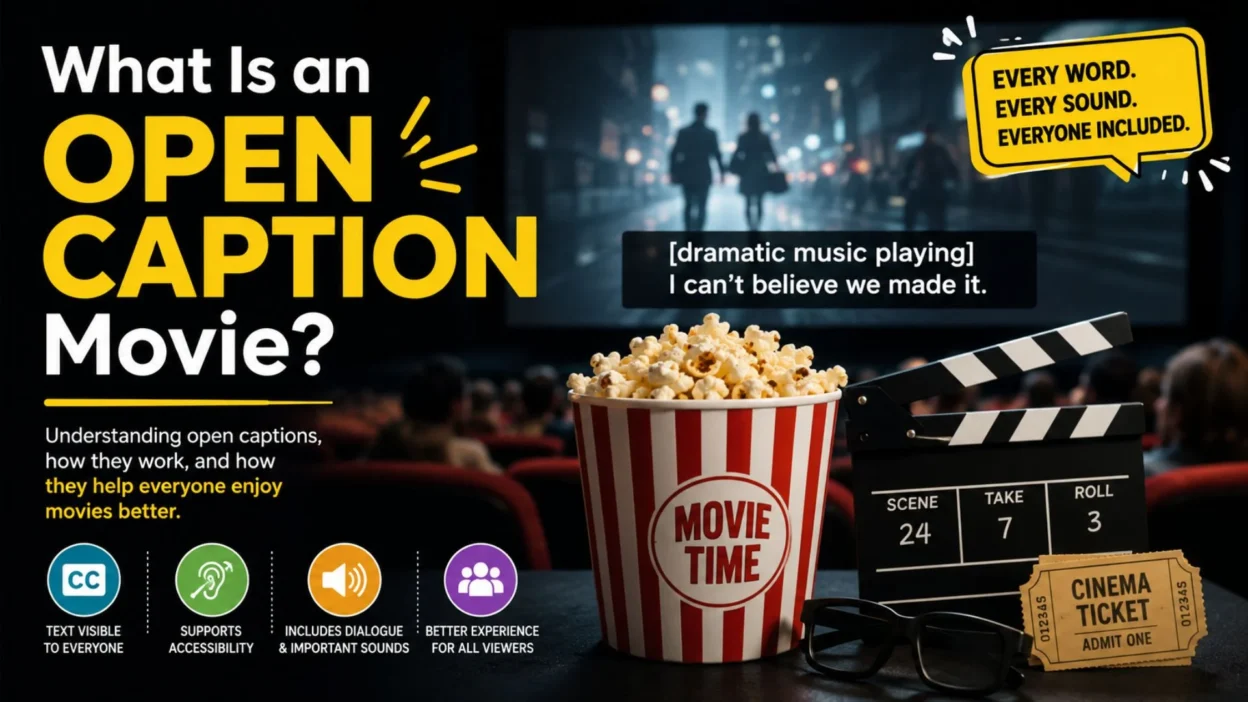
Open captions can make movies easier to follow for people who are deaf or hard of hearing. They can also help when dialogue is difficult to hear, an accent is unfamiliar, or background music is loud. Unlike ordinary subtitles, open captions may include important sounds, such as a phone ringing or a door closing.
This guide explains how open captions work, what information they include, and how they differ from closed captions and subtitles. You will also learn what to expect at a cinema and how to choose the right screening.
What Does Open Caption Mean in a Movie?
Open captions are text displayed on the screen during a film. They usually include spoken dialogue and may also describe important sounds.
The key difference is that open captions are part of the visible presentation. Everyone watching the screening sees them.
What can open captions include?
- Spoken dialogue: The words characters say. 💬
- Speaker identification: A character’s name when it helps clarify who is speaking. 🎭
- Sound descriptions: Important sounds, such as [door creaks] or [phone ringing]. 🔔
- Music descriptions: Notes about relevant music or lyrics when needed for understanding. 🎵
- Non-speech information: Sounds that help explain what is happening in the scene. 🎬
Not every captioned film uses the same style. The exact content depends on the captioning format and the film’s caption track.
How Does an Open Caption Screening Work?
An open caption screening uses a version of the movie that already contains visible captions. The text appears as the film plays.
You do not need to activate a setting or use a special device.
What happens during the movie?
- The film starts normally: The movie plays with captions visible from the beginning. ▶️
- Dialogue appears on screen: Viewers can read the spoken words as they are said. 👀
- Important sounds may be described: Captions can provide context beyond dialogue. 🔊
- Everyone sees the captions: They are not limited to one viewer. 🍿
- The captions continue throughout the screening: They remain part of the presentation. 🎞️
The captions are usually placed near the bottom of the screen, although their position may change to avoid covering important visual details.
Why Do People Watch Open Caption Movies?
Open captions can improve access to films and make dialogue easier to follow. They are useful for many viewers, not only those who need captions for accessibility.
Common reasons to choose an open caption screening
- Accessibility: Captions help viewers who are deaf or hard of hearing follow dialogue and important sounds. 🤝
- Clearer dialogue: Text can help when speech is quiet or difficult to understand. 🎧
- Language support: Captions may help viewers who are learning the language used in the film. 📖
- Less need to adjust volume: Viewers can read dialogue instead of relying only on sound. 🔉
- Shared viewing experience: Everyone in the screening sees the same captions. 👥
- Better understanding of sound: Descriptions can explain important noises that might otherwise be missed. 🎬
Open captions do not replace good audio, but they provide another way to understand what is happening.
Open Captions vs. Closed Captions
The main difference is whether the captions are visible to everyone or can be turned on and off.
FeatureOpen CaptionsClosed CaptionsVisibilityVisible to everyoneCan usually be turned on or offHow they appearPart of the displayed movieUsually provided through a caption setting or deviceViewer controlNo individual off switchViewers can often choose whether to display themCommon useCaptioned cinema screeningsStreaming services, television, and accessible mediaSound descriptionsMay be includedMay be included, depending on the caption track
Open captions are always visible during the screening. Closed captions give the viewer more control over whether the text appears.
Open Captions vs. Subtitles
Subtitles and open captions both display text, but they are not always designed for the same purpose.
Subtitles often focus on spoken dialogue. Open captions may also include sound descriptions and other information that helps viewers understand the film.
The main differences
- Subtitles: Usually focus on dialogue and may translate speech into another language. 🌍
- Open captions: May include dialogue, speaker identification, and important sound descriptions. 🔤
- Subtitles: Often assume the viewer can hear the film’s other sounds. 🎧
- Open captions: Can provide information about sounds that may be important to the story. 🔔
For example, a subtitle might show “I’m leaving.” An open caption may also show “[door slams]” if that sound matters to the scene.
However, the exact format varies. Some subtitle tracks include sound descriptions, and some caption tracks may focus mainly on dialogue.
What Is the Difference Between Open Captions and SDH?
SDH stands for Subtitles for the Deaf and Hard of Hearing. These subtitles usually include dialogue and important non-speech information.
Open captions and SDH can overlap in content. The main difference is how the text is displayed.
How they compare
- Open captions: Always visible during the screening. 👁️
- SDH: A caption or subtitle format that can include sound descriptions and speaker identification. 📝
- Closed SDH: Can usually be turned on or off. ⚙️
- Open SDH: Remains visible to everyone watching. 🎞️
A movie can use SDH-style content in an open caption presentation. The terms describe different aspects of the viewing experience.
Are Open Captions the Same as English Subtitles?
Not always. Both may display English text, but their purpose and content can differ.
English subtitles usually show spoken dialogue. English open captions may also describe sounds and identify speakers.
Example
English subtitles:
I can’t hear you.
English open captions:
[music playing] I can’t hear you.
The second example gives more information about the scene. However, the exact caption style depends on the film and its caption track.
Do Open Caption Movies Include All Sounds?
No. Open captions do not necessarily describe every sound in a film.
They usually include sounds that are important for understanding the scene. The caption track may describe a door closing, a phone ringing, or music that affects the story.
Examples of sounds that may appear
- [door creaks] 🚪
- [phone ringing] ☎️
- [laughter] 😂
- [applause] 👏
- [dramatic music] 🎼
- [car engine starts] 🚗
The goal is to provide useful context, not to describe every sound in the movie.
What Do Open Caption Movies Look Like at the Cinema?
An open caption screening looks like a regular movie screening, except the captions remain visible on the screen.
The captions are usually easy to read and appear in a consistent position. Their style can vary depending on the movie, theater, and captioning format.
What viewers can expect
- The movie plays on the normal cinema screen. 🎥
- Captions appear with the dialogue. 💬
- The text remains visible for everyone. 👀
- Important sounds may be included. 🔊
- The screening follows the movie’s normal timing. ⏱️
If you are unsure about the caption style, check the theater’s screening details or ask staff before booking.
How to Find an Open Caption Movie
Many cinemas identify captioned screenings in their showtimes. The exact wording can vary.
Look for terms such as Open Caption, OC, or other accessibility labels used by the theater.
Ways to find a screening
- Check the movie’s showtimes: Look for an open caption label. 🗓️
- Visit the cinema’s accessibility page: Some theaters explain their captioning options. 🌐
- Ask the box office: Staff can confirm whether captions are visible to everyone. 🎟️
- Check the screening details before booking: Make sure you select the correct showtime. 🔍
- Ask about the caption format: This helps if you need dialogue and sound descriptions. 💬
The availability of open caption screenings depends on the cinema, film, and local scheduling.
How to Choose Between Open Captions and Regular Screenings
The best choice depends on how you prefer to watch movies and what information helps you follow the story.
Open captions may be a good choice if you:
- Prefer reading dialogue: Text can make conversations easier to follow. 📖
- Need captions for accessibility: Open captions provide visible dialogue and sound information. 🤝
- Find some dialogue difficult to hear: Captions can add clarity. 🎧
- Want sound descriptions: Some caption tracks include important non-speech sounds. 🔔
- Enjoy watching with captions: You may prefer having text on screen. 🍿
A regular screening may suit you if you:
- Prefer no text on screen: Some viewers find captions distracting. 🎬
- Want to focus only on the visuals: A standard presentation may feel more natural. 👀
- Do not need or want captions: A regular screening may match your preference. 🎞️
There is no single right choice. The best option is the one that helps you enjoy and understand the movie.
Can Anyone Watch an Open Caption Movie?
Yes. Open caption screenings are generally available to anyone who wants to watch them.
You do not need to be deaf or hard of hearing to attend. Captions can help many viewers follow dialogue and understand important sounds.
Who may enjoy open captions?
- Deaf and partially deaf viewers: Captions support access to spoken dialogue and sounds. 🤝
- People learning English: Reading dialogue can support language understanding. 📚
- Viewers who prefer text: Captions can make dialogue easier to follow. 💬
- People watching with low volume: Captions provide another way to follow the story. 🔉
- Anyone who enjoys captioned films: Open captions are available for general viewing too. 🍿
Open captions are not a separate type of movie. They are a way of presenting the movie with visible text.
Are Open Caption Movies Available on Streaming Services?
Some streaming services offer captions that can be turned on or off. These are usually closed captions, not open captions.
However, a film may also be available with captions permanently included in the video. In that case, the text is part of the video itself.
What to check
- Caption settings: Look for options such as CC, subtitles, or accessibility settings. ⚙️
- Caption type: Check whether the captions can be turned off. 🔍
- Audio and subtitle languages: Confirm that the available language matches your needs. 🌍
- Sound descriptions: See whether the caption track includes important sounds. 🔊
- Video version: Some platforms may offer different versions of the same film. 🎬
If you specifically want open captions, check whether the text is permanently visible rather than simply available as a setting.
What Are Open Caption Movies Called in Other Places?
Different cinemas and services may use different labels for similar captioning options.
The wording can vary, so it is useful to check the screening details rather than rely on one abbreviation.
Common terms you may see
- Open Caption: Captions are visible to everyone. 📝
- OC: A common abbreviation for open caption. 🔤
- Captioned Screening: A screening that includes captions. 🎥
- Open Captioned: Another way to describe a movie with visible captions. 💬
- Closed Caption: Captions that can usually be turned on or off. ⚙️
If a listing is unclear, ask the cinema whether the captions will remain visible throughout the movie.
Do Open Captions Affect the Movie Experience?
Open captions can change how you watch a film, but the effect depends on your preferences.
Some viewers find captions helpful because they make dialogue clearer. Others may need time to adjust to reading while watching the visuals.
What to consider
- Reading speed: Captions appear in time with the dialogue. ⏱️
- Visual attention: You may move your eyes between the text and the scene. 👀
- Dialogue clarity: Captions can help when speech is difficult to hear. 💬
- Sound awareness: Sound descriptions may add useful context. 🔊
- Personal preference: Some viewers enjoy captions, while others prefer a clean screen. 🎬
If you have never watched an open caption movie, trying one can help you decide whether the format suits you.
Common Misunderstandings About Open Captions
Open captions are sometimes confused with subtitles or closed captions. Understanding the differences makes it easier to choose the right screening.
Myth: Open captions are only for deaf viewers
Fact: Anyone can watch an open caption movie. Captions can help with dialogue clarity, language learning, and general understanding.
Myth: Open captions can be turned off
Fact: Open captions are part of the visible presentation. They are not normally controlled by an individual viewer.
Myth: Open captions only show spoken words
Fact: They may also include important sound descriptions and speaker identification.
Myth: Every captioned movie uses the same format
Fact: Caption style and content can vary between films and services.
Myth: Open captions are the same as subtitles
Fact: They can overlap, but open captions may include more information than dialogue alone.
Frequently Asked Questions About What Is Open Caption Movie
What is an open caption movie?
An open caption movie is a film shown with visible captions on the screen. The captions may include dialogue, speaker identification, and important sound descriptions.
Are open captions always visible?
Yes. Open captions remain visible during the screening and are not normally controlled by an individual viewer.
Can anyone watch an open caption movie?
Yes. Open caption screenings are available to anyone who wants to watch them.
What is the difference between open and closed captions?
Open captions are visible to everyone. Closed captions can usually be turned on or off through a setting or device.
Are open captions the same as subtitles?
Not always. Subtitles often focus on dialogue, while open captions may also include important sounds and speaker identification.
Do open captions include sound effects?
They may include important sound effects, such as a door closing or a phone ringing. The exact content depends on the caption track.
What does OC mean on a movie ticket?
OC commonly means Open Caption. It indicates that the screening includes captions visible to everyone.
Are open caption movies available on streaming services?
Some streaming services offer captions that can be turned on or off. Permanently visible captions may also be available in certain video versions.
Do open captions cover the movie screen?
Captions usually appear in a designated area, often near the bottom of the screen. Their placement can vary to avoid covering important visuals.
How can I find an open caption screening?
Check the movie’s showtimes for an Open Caption or OC label. You can also ask the cinema whether the captions will remain visible throughout the screening.
Conclusion
Understanding what is open caption movie makes it easier to choose a screening that fits your needs. Open captions display dialogue and, in some cases, important sound descriptions directly on the screen. Unlike closed captions, they remain visible to everyone watching.
They can help deaf and partially deaf viewers, people who prefer reading dialogue, and anyone who finds certain scenes difficult to hear. They may also support language learners and viewers who enjoy captioned films.
If you want to watch one, check the cinema’s showtimes for an Open Caption or OC label. Before booking, confirm the caption format if you need specific features, such as sound descriptions. With the right screening, captions can make a movie easier to follow and more enjoyable.

I am Ethan Miles, a digital creator and caption enthusiast who loves turning simple moments into powerful words. I specialize in crafting creative, trendy, and engaging captions that help your posts stand out. At Captionestry, I focus on delivering fresh ideas, relatable expressions, and scroll-stopping content for every mood and moment. I’m passionate about social media culture, photography, and the art of storytelling through short, impactful lines.