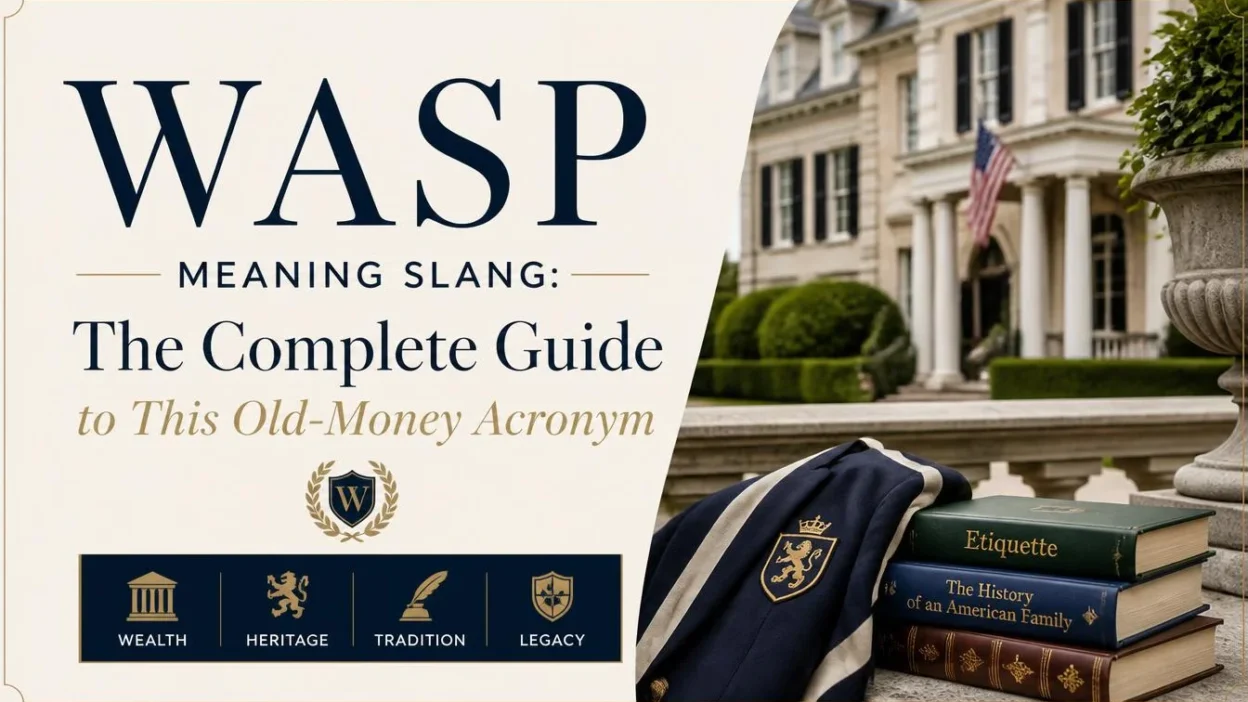
Have you ever heard someone described as a “WASP” and wondered if they were talking about the stinging insect? Perhaps you saw a comment saying someone had “WASP energy” and felt completely lost. The WASP meaning slang has become a powerful cultural shorthand, but understanding it requires knowing its historical roots and modern usage.
The WASP meaning slang stands for “White Anglo-Saxon Protestant.” It describes a specific social type in American culture—someone from an old-money, traditionally privileged background with deep roots in the country’s establishment. Think prep schools, country clubs, boat shoes, and inherited status.
This term was coined in the 1960s by sociologist E. Digby Baltzell . He wanted a concise way to describe the dominant social group in American elite institutions. Over time, it evolved from an academic term into a cultural label that can be descriptive, mocking, or simply observant.
This comprehensive guide will explore everything you need to know about the WASP meaning slang. We will examine its definition and cultural connotations, its origins in academic sociology, and exactly how people use it in modern conversation.
What is the WASP Meaning Slang? The Core Definition
The WASP meaning slang has a clear primary definition, but its cultural implications go far beyond the literal words.
The Primary Definition: White Anglo-Saxon Protestant
At its most basic level, the WASP meaning slang stands for “White Anglo-Saxon Protestant” . This refers to Americans descended from early British and Northern European settlers who belonged to Protestant denominations like Episcopalian, Presbyterian, or Congregationalist.
However, this definition barely scratches the surface. When people use WASP in conversation, they usually mean much more than just race, ethnicity, and religion. The term carries a whole package of cultural associations.
Key aspects of this definition include:
- Race and ethnicity: White, with ancestry from the British Isles
- Religion: Protestant, typically mainline denominations
- Class and status: Old money, inherited privilege, elite education
- Geography: Often associated with the Northeast, especially New England
The Cultural Connotations: Privilege and Establishment
The WASP meaning slang is more about class and culture than theology . It suggests a person who belongs to a family that has been socially established in America for generations—people with a “family background that feels socially protected” .
When someone calls a person or thing “WASPy,” they typically imply:
- Old money: Wealth that has been passed down through generations
- Prep school polish: Education at elite institutions
- Country club energy: A lifestyle of leisure and exclusivity
- Inherited confidence: A sense of entitlement and social ease
- Traditional values: Conservatism and respect for established norms
The term can sound “a little snide, a little amused, or just bluntly class-conscious” . It marks someone as “elite, sheltered, or out of touch” .
The Origins of WASP Slang
The WASP meaning slang has a surprisingly precise origin story rooted in academic sociology.
Coined by E. Digby Baltzell
Sociologist E. Digby Baltzell coined the acronym “WASP” in 1964 . He needed a shorthand term for “White Anglo-Saxon Protestant” to use in the tables of his book, Protestant Establishment: Aristocracy and Caste in America. Baltzell was a University of Pennsylvania professor and a member of the WASP stronghold fraternity St. Anthony Hall .
He probably could not have imagined how much the term would permeate the modern-day lexicon. What started as an academic convenience became a widely recognized cultural label.
From Academia to Popular Culture
By the 1970s and 1980s, the WASP meaning slang had moved beyond sociology departments. It became a way to describe the dominant social group in American elite institutions. People used it in discussions of class, privilege, and power.
Today, the term appears in commentary about elite schools, wealth, politics, family lineage, and polished social circles. It shows up in captions, think-piece replies, and group chats when people want a quick label for that very specific old-money American look .
How to Use WASP Correctly
Now that you understand the WASP meaning slang, here is a quick guide to using it properly.
The Dos
- Use it to describe old-money privilege: “Her family is straight-up WASP, and it shows in every holiday photo” .
- Use it for cultural shorthand: “He has major WASP energy, from the boarding school to the boat shoes” .
- Use it ironically or critically: The term often carries a note of class-conscious amusement.
- Keep it descriptive: It is best used as an observation rather than a personal attack.
The Don’ts
- Avoid using it as a simple insult: It is more of a cultural shorthand than a slur.
- Avoid using it without understanding the context: The term carries built-in stereotypes of privilege and restraint .
- Avoid using it in professional settings unless the context clearly calls for it.
- Avoid confusing it with the insect: In slang, it is almost always an acronym.
Example Sentences
- Describing a person: “He’s the ultimate WASP—prep school, Yale, and a summer house on Nantucket.”
- Describing a vibe: “That ad feels so WASP, like they made it for a country club newsletter” .
- Class commentary: “Her family is straight-up WASP, and you can tell from the way she carries herself.”
Other Meanings of WASP
The WASP meaning slang has a few other, less common definitions:
Women Airforce Service Pilots
In historical contexts, WASP stands for “Women Airforce Service Pilots.” This was a World War II organization that trained female pilots for non-combat missions . This is a completely separate meaning from the slang usage.
Williams, Amherst, Swarthmore, Pomona
Some college students use WASP as an acronym for the top four liberal arts colleges: Williams, Amherst, Swarthmore, and Pomona . This is a niche meaning that only appears in academic contexts.
Slang from Scarface
One Urban Dictionary entry from 2005 defines “wasp” as a general insult used in Scarface, meaning “asshole,” “bitch,” or similar derogatory terms . This is an obscure usage that has largely faded.
FAQ: Your WASP Questions Answered
What does WASP mean in slang?
The WASP meaning slang stands for “White Anglo-Saxon Protestant.” It describes someone from a traditionally privileged, old-money, white Protestant American background.
Is WASP an offensive term?
It can be. The term is “sometimes disparaging and offensive” . It carries a note of class-consciousness and can sound snide or amused .
Where did the WASP term come from?
Sociologist E. Digby Baltzell coined the acronym in 1964 to avoid repeatedly writing out “White Anglo-Saxon Protestant” in the tables of his book .
What does “WASP energy” mean?
“WASP energy” refers to the cultural vibe associated with WASPs—old money, prep school polish, country club leisure, inherited confidence, and traditional values .
Can Catholics or other groups be WASPs?
Traditionally, no—the “P” stands for Protestant. However, some urban dictionary definitions suggest that Catholics in affluent areas like Fairfield County can seem “WASPy as hell” because they have climbed the socioeconomic ladder .
Conclusion
The WASP meaning slang represents one of the most enduring cultural shorthand terms in American English. What started as an academic convenience has become a powerful label for old-money privilege, establishment power, and a very specific American social type.
Understanding the WASP meaning slang is essential for navigating discussions of class, culture, and privilege in modern America. Parents trying to understand their children’s social commentary need this knowledge. Anyone who wants to avoid feeling completely out of touch with cultural conversations needs this knowledge.
The term’s evolution from a 1964 sociology textbook to a 2026 social media label is a testament to how language captures and reflects social structures. The next time you hear someone described as a “WASP” or see “WASP energy” in a comment, you will know exactly what they mean—and you will understand the complex cultural package behind this simple acronym.

I am Ethan Miles, a digital creator and caption enthusiast who loves turning simple moments into powerful words. I specialize in crafting creative, trendy, and engaging captions that help your posts stand out. At Captionestry, I focus on delivering fresh ideas, relatable expressions, and scroll-stopping content for every mood and moment. I’m passionate about social media culture, photography, and the art of storytelling through short, impactful lines.