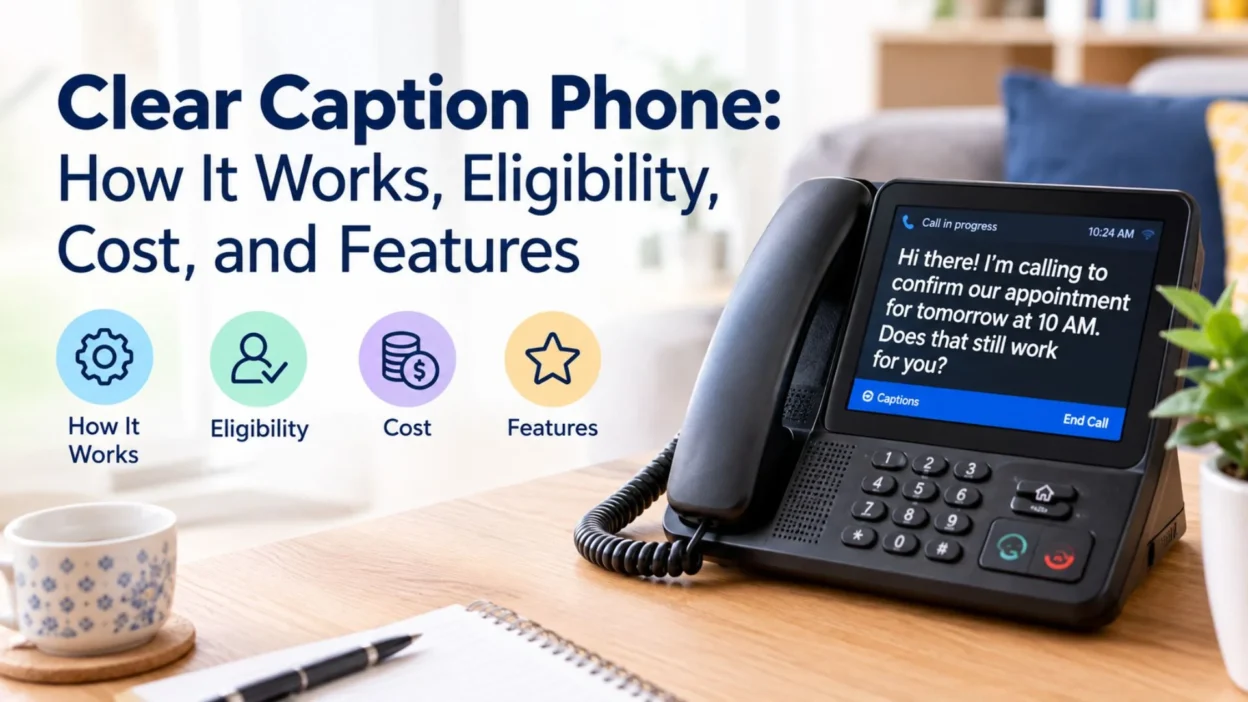
ClearCaptions is one service that provides captioned telephone technology to qualified users in the United States. Its caption phone uses an internet connection and displays captions while a person talks. The service is available at no cost to eligible users through the federally supported IP Captioned Telephone Service program.
This guide explains how a clear caption phone works, who may qualify, what you need, how the setup works, and what to consider before choosing this type of phone.
What Is a Clear Caption Phone?
A clear caption phone is a telephone that displays the caller’s spoken words as text while the conversation is happening. It can be especially useful when hearing every word over a normal phone call is difficult.
Instead of depending entirely on audio, the user can listen and read at the same time. This can help when a caller speaks quickly, has a soft voice, or when certain words are difficult to understand.
A caption phone can provide:
• Spoken conversations with on-screen captions for easier understanding. 🗣️ • A large display that lets users read what the caller says. 📱 • Support for people who have hearing loss and need captions during calls. 👂 • An alternative to relying only on amplified sound. 🔊 • A more accessible way to stay connected with family and friends. ❤️
ClearCaptions describes its service as an IP Captioned Telephone Service designed for people whose hearing loss requires captions to use the telephone.
How Does a Clear Caption Phone Work?
The basic idea is simple: you talk and listen normally while the caller’s speech is converted into text that appears on the screen. This gives you another way to follow the conversation.
During a captioned call, the captioning service processes the other person’s spoken words and sends the resulting captions to the phone. ClearCaptions notes that its IP CTS service may use a live operator to generate captions.
What happens during a call?
• You start or answer a phone call using the caption phone. ☎️ • You listen to the caller through the phone. 🎧 • Captions of the caller’s words appear on the display. 📝 • You can look at the screen when you miss or cannot clearly hear a word. 👀 • You continue speaking normally while using the captions for additional support. 💬
There can be a short delay between spoken words and displayed captions because the speech must be detected and captioned.
Who Can Qualify for a Clear Caption Phone?
Eligibility is important because captioned telephone service is provided under a federally supported accessibility program. ClearCaptions currently lists several requirements for its service.
According to ClearCaptions, potential users generally need to meet these conditions:
• Have hearing loss that requires captions to use the phone. 👂 • Live in the United States or its territories. 🇺🇸 • Have reliable internet access. 🌐 • Be able to communicate in English because the current captioning service is offered in English. 🗣️
ClearCaptions says eligible users complete a self-certification process and do not need medical documentation or a doctor’s signature for its current enrollment process.
A person who does not have hearing loss should not use the captioning function simply because the phone is available. Federal rules restrict use of IP captioned telephone captions to registered users who need the service because of hearing loss.
Is a Clear Caption Phone Free?
For qualified users, ClearCaptions says both its caption phone and captioning service are provided at no cost. The service is supported through the federally administered Telecommunications Relay Services fund.
This does not mean everyone can automatically receive a free phone. Eligibility requirements still apply.
The important points are:
• Qualified users can receive the ClearCaptions Phone at no cost. 💰 • The captioning service is also provided at no cost to eligible customers. 🆓 • The program is supported through the TRS fund rather than ordinary customer payment. 🏛️ • Users still need the required internet connection and must meet eligibility requirements. 🌐 • Availability is limited to eligible people in the United States and its territories. 🇺🇸
ClearCaptions says the federally managed program covers the captioning costs for people who qualify.
Clear Caption Phone Features to Look For
Not every caption phone or accessibility device works in exactly the same way. However, several features can make a captioned telephone easier to use.
Large, readable captions
A clear screen can make captions easier to read, especially for people who prefer larger text.
Adjustable caption settings
ClearCaptions installation materials describe options such as adjusting caption font size and caption speed to the user’s preference.
Touchscreen controls
ClearCaptions describes its phone as having a touchscreen interface designed to make the device easier to navigate.
Hearing aid compatibility
Some people use captioning alongside hearing aids or cochlear implants. ClearCaptions specifically discusses its service for people who still have difficulty following telephone conversations while using hearing technology.
Customer support
Support can be particularly useful during installation and when learning a new accessibility device. ClearCaptions says its specialists can provide setup assistance and training.
Clear Caption Phone vs. a Regular Phone
A regular phone depends mainly on audio. A caption phone adds text to the conversation, giving users another way to understand what is being said.
FeatureRegular PhoneCaption PhoneAudio conversationYesYesOn-screen captionsUsually noYesUseful for hearing lossSometimesDesigned for this needInternet requirementDepends on phone/serviceRequired for ClearCaptionsText support during callsUsually noYesAccessibility-focused designVariesYes
The biggest difference is the additional visual information. Instead of asking someone to repeat every unclear sentence, a user can look at the displayed captions.
Can You Use a Clear Caption Phone With Hearing Aids?
Yes, captioning can be useful for people who wear hearing aids but still struggle with telephone conversations. Hearing aids can improve access to sound, while captions provide a visual backup when speech remains difficult to understand.
For example, a user might:
• Listen through their hearing device while reading captions. 🎧 • Check the screen when a name or number is unclear. 🔎 • Use captions when background noise makes a call harder to follow. 📞 • Continue speaking naturally instead of relying entirely on text. 💬
ClearCaptions specifically notes that people with hearing aids or cochlear implants may still benefit from captioned telephone service when hearing phone conversations remains difficult.
How to Get a Clear Caption Phone
Getting started generally involves checking eligibility, completing registration, and setting up the device. ClearCaptions says its enrollment process typically takes around 10 minutes, although individual experiences can vary.
Basic process
• Contact a ClearCaptions specialist to begin the process. 📞 • Answer questions about hearing loss, location, internet access, and English communication. ✅ • Complete the required self-certification process. 📝 • Arrange delivery and setup after eligibility is confirmed. 📦 • Learn how to use captions and adjust the phone to your preferences. 🎓
ClearCaptions says a specialist can help with setup and provide training after approval.
Does a Clear Caption Phone Need Internet?
Yes. ClearCaptions requires internet access for its captioning service. This is an important difference from some traditional landline phones.
A reliable internet connection helps the phone communicate with the captioning service during calls. ClearCaptions lists internet access as one of its eligibility and service requirements.
Before getting the service, consider:
• Whether your home has a reliable internet connection. 🌐 • Whether the internet works consistently in the room where you use the phone. 🏠 • Whether your router is positioned for a stable connection. 📡 • Whether someone can help with setup if you are unfamiliar with internet-connected devices. 🛠️
Can You Use Captioning on a Mobile Phone?
Captioned calling is not limited to a dedicated home phone. ClearCaptions also offers a mobile application for eligible users.
The ClearCaptions Mobile App can provide captioned calls on compatible Apple mobile devices and requires internet access through Wi-Fi or cellular data.
The mobile option can be useful for people who want captioned calls while away from home.
ClearCaptions says its mobile service can provide a ClearCaptions number that users can share with people they want to contact them through the captioning service.
Clear Caption Phone if possible
A caption phone can be helpful if possible who find ordinary phone conversations difficult to understand. The ability to read a caller’s words can reduce the pressure of trying to catch every spoken word.
Useful situations may include:
• Talking with children or grandchildren. 👨👩👧👦 • Speaking with a doctor’s office. 🩺 • Calling customer service. ☎️ • Talking with friends who live far away. 🌎 • Handling important personal calls more independently. 🏡 • Following conversations without constantly asking people to repeat themselves. 💬
ClearCaptions specifically markets its caption phone if possibles and people with hearing loss.
Privacy and Clear Caption Phones
Privacy is an important question because captions appear during personal conversations. ClearCaptions states that it follows FCC confidentiality requirements and says its captioned calls are not recorded by ClearCaptions.
According to ClearCaptions, captions generated during calls remain on the user’s phone after the call rather than being stored by ClearCaptions or an outside party.
Still, users should understand their device’s settings and protect physical access to the phone.
Good habits include:
• Keep your phone in a private location. 🔒 • Avoid allowing unauthorized people to use your registered captioning service. 🛡️ • Review device settings if other people have access to your phone. ⚙️ • Contact the provider if you have questions about privacy or caption history. 📞
What Are the Benefits of a Clear Caption Phone?
The biggest advantage is simple: captions provide another way to understand a phone conversation. That can make communication feel more manageable when hearing alone is not enough.
Potential benefits include:
• Easier conversations when speech is difficult to hear. 👂 • Visual access to the caller’s words. 👀 • Better support for users with hearing loss. 🤝 • More confidence during important phone calls. 💪 • A useful communication option alongside hearing aids. 🎧 • Greater independence for some users. 🌟 • Easier communication with family, friends, and service providers. ❤️
These benefits can vary from person to person. A caption phone is an accessibility tool, not a replacement for every hearing technology or communication method.
Things to Consider Before Getting a Caption Phone
A caption phone can be useful, but it is not right for every situation. Understanding its requirements beforehand can help you decide whether it fits your needs.
Consider these points:
• The service may require reliable internet access. 🌐 • Eligibility rules apply. 📋 • ClearCaptions’ current service is available in English. 🗣️ • Captioning may have a slight delay. ⏱️ • Captioned telephone services are intended for people who meet the applicable hearing-loss requirements. 👂 • Emergency calling features and limitations should be understood before relying on the service. 🚨
ClearCaptions includes specific 911 and emergency-calling limitations in its service terms, so users should review the current terms and instructions provided with their service.
Frequently Asked Questions About Clear Caption Phone
Here are concise answers to common questions people have before choosing a captioned telephone.
What is a clear caption phone?
A clear caption phone displays a caller’s spoken words as text during a telephone conversation. It is designed to help people with hearing loss follow calls more easily.
Is ClearCaptions really free?
ClearCaptions says its caption phone and captioning service are provided at no cost to qualified users through a federally supported program.
Who can get a ClearCaptions Phone?
People with hearing loss who need captions to use the phone may qualify if they meet the other requirements, including U.S. residency, internet access, and English communication ability.
Do I need a doctor’s note?
ClearCaptions currently says that medical documentation or a doctor’s signature is not required for its self-certification process.
Can I use a caption phone with hearing aids?
Yes. Captioning can provide additional visual support for people who use hearing aids or cochlear implants but still have difficulty following phone conversations.
Does a ClearCaptions Phone require internet?
Yes. Internet access is required for the ClearCaptions service.
Can captions be used on a mobile phone?
ClearCaptions offers a mobile app for eligible users, allowing captioned calls on supported Apple mobile devices with internet access.
Are ClearCaptions calls recorded?
ClearCaptions says it does not record captioned calls. It also states that captions can remain on the user’s own device after a call ends.
Can someone without hearing loss use the caption feature?
No. Federal rules restrict IP captioned telephone captions to registered users who have hearing loss requiring the service.
How do I start the ClearCaptions application process?
You can contact ClearCaptions to check eligibility and begin registration. The company says a specialist can guide users through eligibility, certification, setup, and training.
Conclusion
A clear caption phone can give people with hearing loss an important extra way to follow telephone conversations. Instead of depending only on sound, users can read captions on the screen while listening and speaking normally. This can be particularly useful for everyday conversations, family calls, appointments, and other situations where missing a few words can create confusion.
ClearCaptions currently provides captioned telephone service at no cost to qualified U.S. residents who meet its eligibility requirements. Internet access is required, and users must complete the appropriate registration and self-certification process.
If you or someone you care for struggles to understand phone conversations because of hearing loss, a captioned telephone may be worth considering. Review the current eligibility requirements, understand how the service works, and choose the communication setup that feels most comfortable and practical.

I am Ethan Miles, a digital creator and caption enthusiast who loves turning simple moments into powerful words. I specialize in crafting creative, trendy, and engaging captions that help your posts stand out. At Captionestry, I focus on delivering fresh ideas, relatable expressions, and scroll-stopping content for every mood and moment. I’m passionate about social media culture, photography, and the art of storytelling through short, impactful lines.