
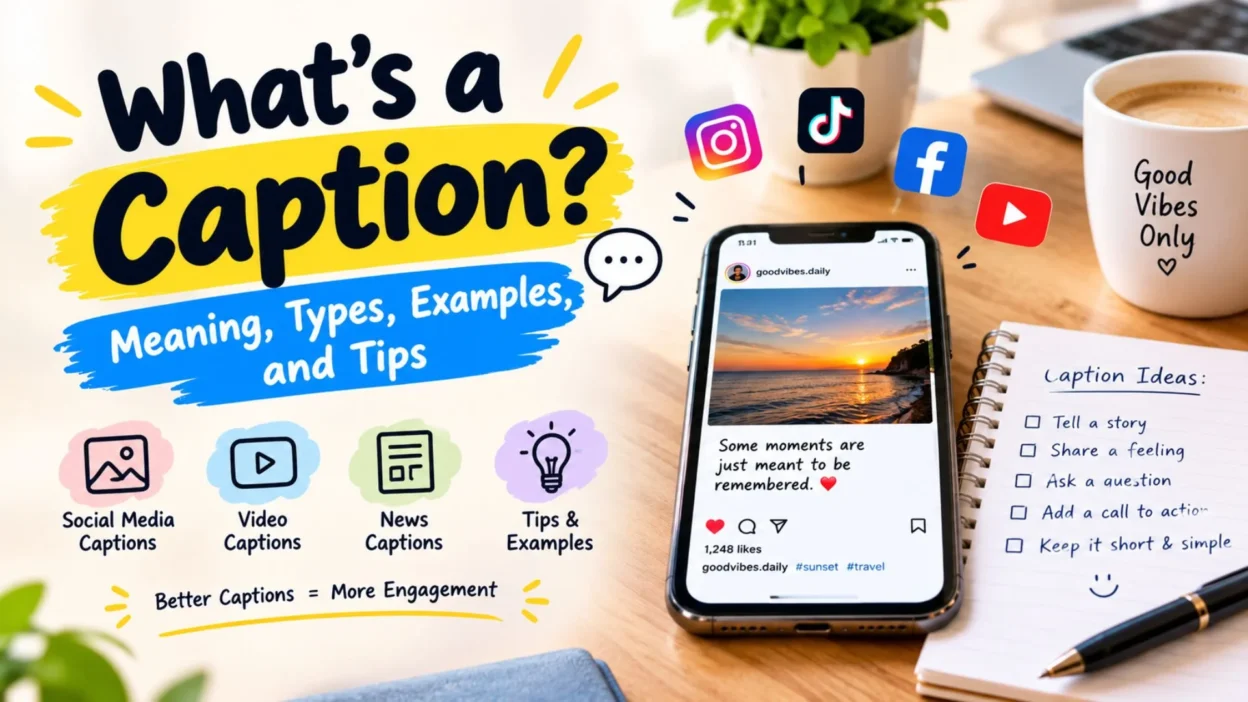
However, a caption can do more than simply describe what you see. It can tell a story, share a feeling, explain an idea, or encourage people to interact with a post. For example, a photo of a sunset might have a simple caption such as “Chasing sunsets,” while a business post might use a caption to explain a product or invite customers to learn more.
The meaning can also change depending on the context. In video content, captions can display spoken words and important sounds. So, understanding what a caption means helps you use the right type of caption for the right situation.
What Is a Caption?
A caption is text placed with or alongside visual content to explain, describe, or add meaning to it.
Captions are common in social media, journalism, entertainment, education, and everyday communication. Their purpose depends on where they appear.
For example, a social media caption may express an opinion or feeling. On the other hand, a news caption may provide important information about a photograph.
A good caption usually supports the main content rather than distracting from it. It gives readers additional context and can make a post easier to understand.
In simple terms, a caption answers a question such as:
“What should people know, feel, or understand about this image or video?”
What Does Caption Mean on Social Media?
On social media, a caption is the text that accompanies a photo, video, reel, or other post.
It can be short and casual, or it can be longer and informative. The style usually depends on the platform and the purpose of the post.
For example, someone sharing a beach photo might write:
• “A little sunshine goes a long way. ☀️”
A business might use:
• “New arrivals are here. Explore the latest styles today. 🛍️”
A creator could use a question to encourage interaction:
• “Which one would you choose? 👀”
Therefore, social media captions are not limited to descriptions. They can also communicate personality, provide information, and encourage engagement.
Why Are Captions Important?
Captions can make visual content more meaningful and easier to understand.
A strong caption gives the audience context. It can also help a creator communicate an idea that may not be obvious from an image alone.
Here are some common reasons people use captions:
• To explain what is happening in a photo or video. 📝
• To share a personal thought or feeling. 💭
• To tell a short story behind an image. 📖
• To provide useful information to readers. 💡
• To encourage comments and conversations. 💬
• To promote a product, service, event, or website. 📢
• To add humor or personality to a social media post. 😄
• To give important context that the visual cannot provide alone. 🔎
For this reason, a caption can be a small part of a post but still play an important role in communication.
What Are the Different Types of Captions?
There is no single type of caption. The best format depends on the content, audience, and purpose.
Social Media Captions
Social media captions accompany posts on platforms such as Instagram, Facebook, and other social networks.
They can be funny, emotional, informative, promotional, or conversational.
• “Collecting memories, not things. ✨”
• “Good food, better company. 🍽️”
• “Small moments can make the biggest memories. 🌸”
Photo Captions
A photo caption explains or adds context to a picture.
For example, a travel photo might mention the location, activity, or story behind the moment.
• “Morning views from the mountain trail. 🏔️”
A photo caption can be very simple when the image already tells most of the story.
Video Captions
Video captions display spoken dialogue as text on the screen. They can help viewers follow the conversation, especially when audio is unavailable or difficult to hear.
Depending on the captioning system, they may also include information about important sounds.
For example, a caption might identify:
• “[Music playing] 🎵”
• “[Door closes] 🚪”
• “[Audience laughing] 😂”
This type of caption is different from a social media caption because it is part of the video viewing experience.
News Captions
News organizations often use captions to explain photographs.
A news photo caption may identify people, places, events, or other relevant details. It helps readers understand why the image matters.
Because accuracy is important in journalism, news captions should be clear and factual.
Product Captions
Businesses use product captions to describe items and provide useful details.
A product caption might mention a feature, benefit, price, or reason to visit a store or website.
• “A simple everyday style designed for easy wear. 👕”
The best product captions focus on useful information instead of making unsupported claims.
Funny Captions
Funny captions add humor to a photo or video.
They work especially well when the visual already has a playful or unexpected element.
• “I came, I saw, I took a picture. 📸”
• “Proof that I left the house today. 😎”
A funny caption does not need to be complicated. Often, a short punchline works better.
What Is the Difference Between a Caption and a Subtitle?
Captions and subtitles are related, but they are not always used for the same purpose.
A subtitle generally provides the spoken dialogue from a video, often for viewers who understand the language but cannot hear the audio clearly.
A caption can include spoken dialogue as well as relevant audio information. For example, it may indicate music, laughter, or other important sounds.
The terms can overlap, especially on streaming platforms and social media. However, the context usually makes the intended meaning clear.
For example, a person asking for a “caption” for an Instagram photo usually means the text written with the post. Someone looking for “closed captions” on a video usually means on-screen text that represents dialogue and relevant sounds.
What Is a Caption on Instagram?
On Instagram, a caption is the text written with a post, photo, carousel, or video.
Instagram captions can be used for many purposes. A creator may use one to tell a story, express a feeling, explain an image, or start a conversation.
For example:
• “Weekend mood: slow mornings and good coffee. ☕”
• “This view was worth the long walk. 🌄”
• “What would you add to this look? 👗”
A caption can also include hashtags, mentions, calls to action, or other relevant information.
The key is to make the text useful and natural. A caption should support the post instead of simply repeating what the viewer can already see.
What Is a Caption on TikTok?
On TikTok, the word “caption” can refer to the text written with a video. It can also be confused with on-screen captions that display spoken words.
A TikTok post caption can provide context or add personality to a video.
For example:
• “When the plan actually works for once. 😂”
• “Wait for the ending. 👀”
• “Trying something new today. ✨”
Meanwhile, accessibility captions appear within the video and represent spoken content or relevant sounds.
Therefore, the meaning depends on how the word is being used.
How Do You Write a Good Caption?
Writing a good caption does not have to be difficult. Start by thinking about the purpose of the post.
Ask yourself what you want the reader to understand or feel.
Then choose a style that matches the content.
Start With the Main Idea
First, identify the main message.
If you are sharing a travel photo, your caption might focus on the place. If you are sharing a personal photo, it might focus on the memory.
For example:
• “A peaceful afternoon by the lake. 🌊”
This works because the message is clear and matches the image.
Keep It Natural
Avoid writing a caption that sounds forced.
Instead, use words that match your normal communication style. A simple sentence can often feel more genuine than an overly complicated one.
Add Context
If the image does not tell the whole story, give readers a little more information.
For example, instead of:
• “Great day! ☀️”
you could write:
• “A beautiful day exploring the old streets of the city. 🏙️”
The second version gives the reader more context.
Use a Call to Action When Appropriate
A call to action tells readers what they can do next.
For example:
• “Which color would you choose? 🎨”
• “Save this idea for later. 📌”
• “Tell us your favorite in the comments. 💬”
However, not every caption needs a call to action. Use one when it makes sense for the post.
Match the Mood
A caption should fit the visual.
A serious photograph usually needs a different tone from a funny meme. Similarly, a business announcement should sound different from a personal vacation post.
Matching the mood helps the caption feel connected to the content.
What Makes a Caption Engaging?
An engaging caption gives people a reason to pause and read.
It does not necessarily need to be long. Instead, it should offer something useful, interesting, emotional, or entertaining.
A strong caption can use:
• A simple question that invites a response. ❓
• A short story behind the image. 📚
• A surprising observation. 😮
• A relatable feeling. ❤️
• A useful piece of information. 💡
• A playful joke or clever line. 😄
• A clear reason to take action. 👉
For instance, “Nice day” is simple but gives the audience little to respond to.
“Would you spend your morning here?” creates a natural opportunity for interaction.
Short Caption Ideas
Sometimes a photo does not need a long explanation. A few words can be enough.
Here are some short caption ideas:
• “Just enjoying the moment. ✨”
• “Simple days, happy heart. 🤍”
• “Making memories. 📸”
• “Good energy only. ☀️”
• “Peace looks good here. 🌿”
• “A moment worth keeping. 💫”
• “Currently feeling grateful. 🙏”
• “Keeping it simple. 🖤”
• “Here for the memories. 🌸”
• “Let the good times roll. 🎉”
Funny Caption Ideas
Humor can make a caption more memorable when it fits the post.
Try keeping the joke connected to the photo instead of forcing a random punchline.
• “I had a plan. Then I took this picture. 😂”
• “My camera roll has entered the chat. 📸”
• “Professional overthinker, part-time photographer. 🤣”
• “Serving looks and questionable decisions. 😎”
• “I came for the view and stayed for the snacks. 🍿”
• “Evidence that I occasionally go outside. 🌳”
• “Mood: pretending I know what I’m doing. 😅”
What Is a Caption Used For?
Captions are used in many different situations.
They can support visual content, provide information, or improve accessibility.
Common uses include:
• Social media posts and stories. 📱
• Instagram photos and reels. 📸
• TikTok videos. 🎬
• YouTube videos. ▶️
• News photographs. 📰
• Educational videos and presentations. 🎓
• Marketing and advertising content. 📣
• Product photos and online stores. 🛒
• Personal photo albums. 🖼️
• Television and streaming content. 📺
Because the word has several uses, it is important to consider the context before deciding what “caption” means.
Caption vs. Description: What’s the Difference?
A caption and a description can look similar, but they usually serve different purposes.
A caption is often short and directly connected to a photo, video, or post. It may provide context, personality, or a message.
A description is usually more detailed. It explains what something is, how it works, or what it contains.
For example, a social media caption might say:
• “A quiet morning by the water. 🌊”
A more detailed description could explain the location, weather, surroundings, and other visual details.
In short, a caption adds context or personality, while a description generally provides fuller information.
How Long Should a Caption Be?
There is no single perfect caption length.
The right length depends on the platform, audience, content, and purpose.
A simple personal photo may need only a few words. However, a business announcement or storytelling post may benefit from more detail.
A useful rule is to write enough to communicate the idea clearly without adding unnecessary words.
If the image already explains everything, a short caption may be best. If the reader needs background information, a longer caption can make more sense.
Therefore, focus on clarity and usefulness rather than length.
Common Caption Mistakes to Avoid
Even a simple caption can lose its impact when it is unclear or unrelated to the content.
Avoid these common problems:
• Writing a caption that has nothing to do with the visual. 🚫
• Adding unnecessary words just to make the caption longer. ✂️
• Using an overly formal tone for a casual post. 🎭
• Making unsupported claims about a product or service. ⚠️
• Repeating the same caption style in every post. 🔄
• Using too many hashtags when they do not add value. #️⃣
• Forgetting important context when the image needs explanation. 🔎
• Using jokes that do not match the audience or situation. 😬
A good caption should feel like a natural extension of the content.
Frequently Asked Questions About What’s a Caption
What’s a caption in simple words?
A caption is text that goes with an image, video, or post. It can explain the content, share a thought, provide context, or add personality.
What does caption mean on Instagram?
On Instagram, a caption is the written text that accompanies a photo, carousel, or video post. It can describe the post, tell a story, or encourage interaction.
What is the purpose of a caption?
The purpose of a caption is to add meaning or context to visual content. Depending on the situation, it can also entertain, inform, promote, or start a conversation.
Is a caption the same as a subtitle?
Not always. A subtitle generally represents spoken dialogue, while captions can also include relevant sounds and other audio information. However, the terms can overlap on some platforms.
What is a caption on TikTok?
A TikTok caption can mean the text written with a video post. It may also be confused with on-screen captions that display spoken words.
Can a caption be one word?
Yes. A caption can be one word if that word effectively matches the image or communicates the intended feeling.
How do I make a caption interesting?
Start with a clear idea and use a tone that matches the content. You can also add a question, short story, useful detail, joke, or call to action when appropriate.
Does every photo need a caption?
No. Some photos can stand on their own. However, a caption can provide useful context or give the audience a better understanding of the image.
What is a closed caption?
A closed caption is on-screen text that represents spoken dialogue and, when relevant, important sounds in video content. Viewers can generally turn closed captions on or off.
What is a good caption for social media?
A good social media caption is clear, natural, and relevant to the post. It should match the audience and purpose rather than follow a fixed formula.
Conclusion
So, what’s a caption? Simply put, it is text that adds context, meaning, or personality to visual content. The exact purpose depends on where the caption appears.
On social media, captions can tell stories, express emotions, make people laugh, or encourage conversation. In news and photography, they can explain important details about an image. In video content, captions can represent spoken dialogue and relevant sounds.
The best caption is not necessarily the longest or cleverest one. Instead, it should fit the content and communicate the intended message clearly. Before writing, think about your audience, the purpose of the post, and the feeling you want to create.
Once you understand these basics, writing captions becomes much easier. Start with the main idea, keep your wording natural, add useful context when needed, and let the visual content do some of the work.

I am Ethan Miles, a digital creator and caption enthusiast who loves turning simple moments into powerful words. I specialize in crafting creative, trendy, and engaging captions that help your posts stand out. At Captionestry, I focus on delivering fresh ideas, relatable expressions, and scroll-stopping content for every mood and moment. I’m passionate about social media culture, photography, and the art of storytelling through short, impactful lines.