Have you ever visited Scotland and felt completely lost when a local said “Haud yer wheesht!”? Perhaps you heard someone call another person a “bampot” and wondered if that was a compliment or an insult. The Scottish slang is a rich, colorful, and sometimes baffling part of the country’s culture, woven into everyday conversation.
The Scottish slang is not just a dialect—it is a living, breathing part of Scottish identity. It includes the Scots language (which some wrongly call a dialect), Gaelic-influenced terms, and more recent slang that has evolved across the country . From “aye” to “dreich,” these words paint a picture of a unique culture that values humor, warmth, and a good “blether.”
This comprehensive guide will take you through everything you need to know about Scottish slang. We will break down essential everyday words, phrases for people and personalities, weather-related slang, and some of the most hilarious insults the Scots have to offer. By the end, you will be able to “sound like a local” and maybe even impress a few Scots with your new linguistic skills.
Essential Everyday Scottish Slang
If you want to understand Scottish slang, these are the words you will hear constantly. They are the foundation of everyday conversation.
The Basics: Yes, No, and Know
- Aye: Meaning “yes,” this is perhaps the most Scottish word there is . You will hear it constantly, often with a firm nod .
- Naw or Nae: Meaning “no.” “Nae” often combines with other words, such as “nae bother” (no problem) or “nae chance” .
- Ken: Meaning “know” or “understand.” This word slips easily into conversation, especially at the end of a sentence. For example, “We can’t go outside because it’s snowing, ya ken?” . It is particularly common in the East of Scotland and Edinburgh .
Describing the World
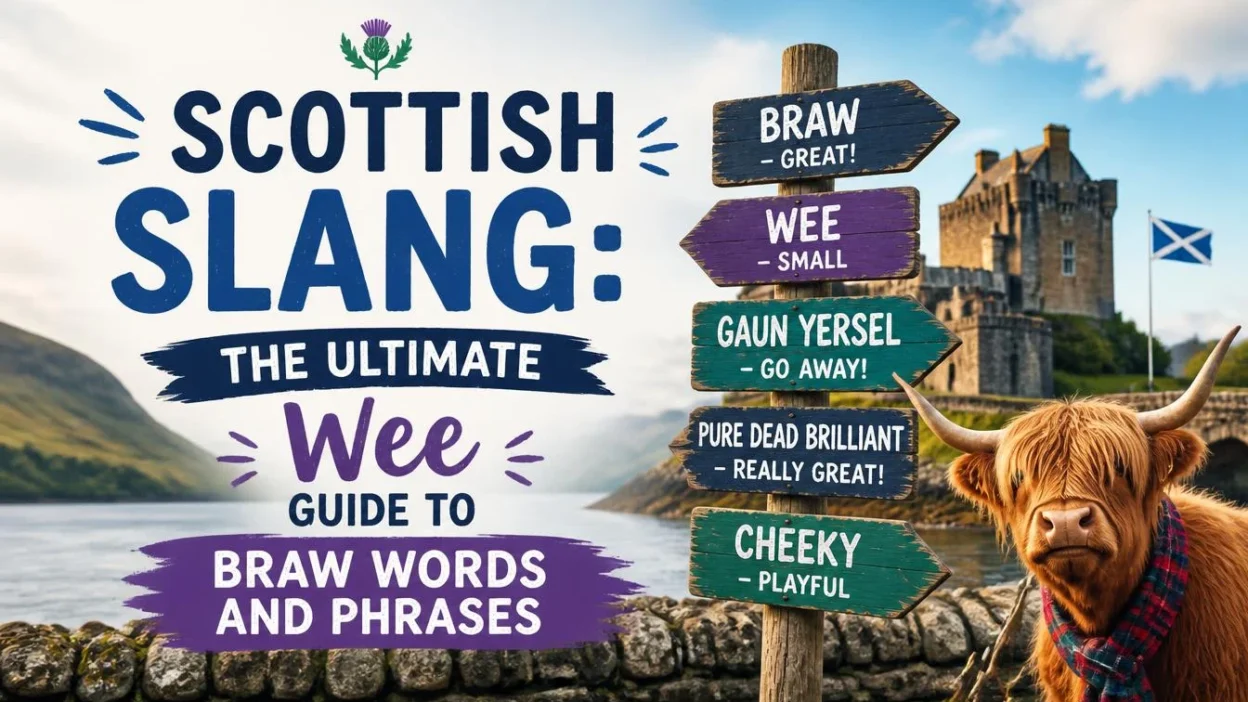
- Wee: Meaning “small” or “little.” In Scotland, the word “wee” applies to far more than just size. You might be offered a “wee cup of tea,” a “wee walk,” or a “wee dram” (whisky), even when the thing itself isn’t actually that small .
- Braw: An all-purpose word meaning “great,” “lovely,” “fine,” or “excellent.” You might hear it describing the weather or a beautiful view: “It’s a braw day today!” .
- Bonnie: Meaning “beautiful” or “pretty,” this word is often used to describe the Scottish landscape or a person. Scotland itself is often called “bonnie” .
- Dreich: This is the quintessential Scottish weather word. It means “miserable, grey, dreary, or drizzly” . It perfectly captures those misty, overcast Scottish days.
- Baltic: Meaning “freezing cold.” If a Scot says it is “baltic,” they really mean it .
Scottish Slang for People
Scots have a rich vocabulary for talking about people—some affectionate, some critical, but all memorable.
Family and Relationships
- Bairn: A traditional word for a “child” or “baby,” still widely used today .
- Wean: Used in the west of Scotland to mean a “child,” similar to “bairn” .
- Da: A casual term for “dad” .
- Auld yin: Literally “old one,” used affectionately to refer to an old person or one’s father or mother .
- Lad / Lass (or Lassie): Meaning “boy/man” and “girl/woman” respectively . These are used in friendly contexts.
Insults and Character Descriptions
- Numpty / foolish / Eejit: All used to call someone a “silly” or “foolish” person . “Eejit” is a common term for “idiot” .
- Bampot / Rocket / Tube: These are also words for an “eccentric,” “foolish,” or “ridiculous” person . They are often used humorously .
- Bawbag / Dobber / Walloper: These are more derogatory terms, often used to describe an irritating or foolish individual . They originate from words for genitalia but have become broader terms of derision.
- Gallus: Meaning “bold, cheeky, or confident” . This is often said with admiration.
- Crabbit: Meaning “grumpy” or “bad-tempered” . You might hear this about someone who is irritable before their morning coffee .
- Glaikit: Meaning “silly,” “foolish,” or “vacant-looking” . It is often used teasingly.
The Art of Scottish Banter
Understanding the Scottish slang for banter is key to getting the culture. It is fast, sarcastic, affectionate, brutal, and hilarious—often all at once .
Banter Phrases
- “Away an bile yer heid”: Literally, “away and boil your head.” This is a way of telling someone to “go away” or “don’t be ridiculous,” often said with mock outrage .
- “Yer aff yer heid”: Meaning “you’re out of your mind” or “being ridiculous.”
- “That’s boggin”: Meaning “that’s disgusting” or “unpleasant” .
- “Gie it laldy”: Meaning “go all in” or “give it everything” . Often heard at weddings, football matches, or karaoke nights.
- “Haud yer wheesht”: Meaning “be quiet” or “shut up” .
The rules of Scottish banter are simple: if someone is teasing you, you’re in. If they are silent, you are not worth the effort. And you must give as good as you get .
FAQ: Your Scottish Slang Questions Answered
What is the most common Scottish slang word?
“Aye” (meaning yes) and “wee” (meaning small) are among the most common words you will hear .
What does “braw” mean in Scottish slang?
“Braw” is a positive word meaning “great, fine, lovely, or excellent” .
What does “dreich” mean?
“Dreich” is a weather term meaning “miserable, grey, dreary, or drizzly” .
Is “ken” a Scottish word?
Yes, “ken” means “to know” or “understand.” It is used widely in Scotland, particularly in the East and Edinburgh .
What does “numpty” mean?
“Numpty” is a Scottish word for a “foolish” or “silly” person .
How do you say “be quiet” in Scottish slang?
Conclusion
The Scottish slang is a vibrant and essential part of the country’s culture. It is more than just a collection of words—it is a reflection of the Scottish spirit: humorous, warm, and always ready for a good “blether.” From the ubiquitous “aye” to the colorful insults like “bampot,” these words connect people and create a unique sense of identity.
Whether you are planning a trip to the Highlands, trying to understand a Scottish TV show, or simply want to impress your friends, a wee guide to Scottish slang is a great place to start. The key is to remember the rules of banter: don’t take it too seriously, give as good as you get, and if you hear “away an bile yer heid,” you have just been welcomed into the conversation.
I am Ethan Miles, a digital creator and caption enthusiast who loves turning simple moments into powerful words. I specialize in crafting creative, trendy, and engaging captions that help your posts stand out. At Captionestry, I focus on delivering fresh ideas, relatable expressions, and scroll-stopping content for every mood and moment. I’m passionate about social media culture, photography, and the art of storytelling through short, impactful lines.