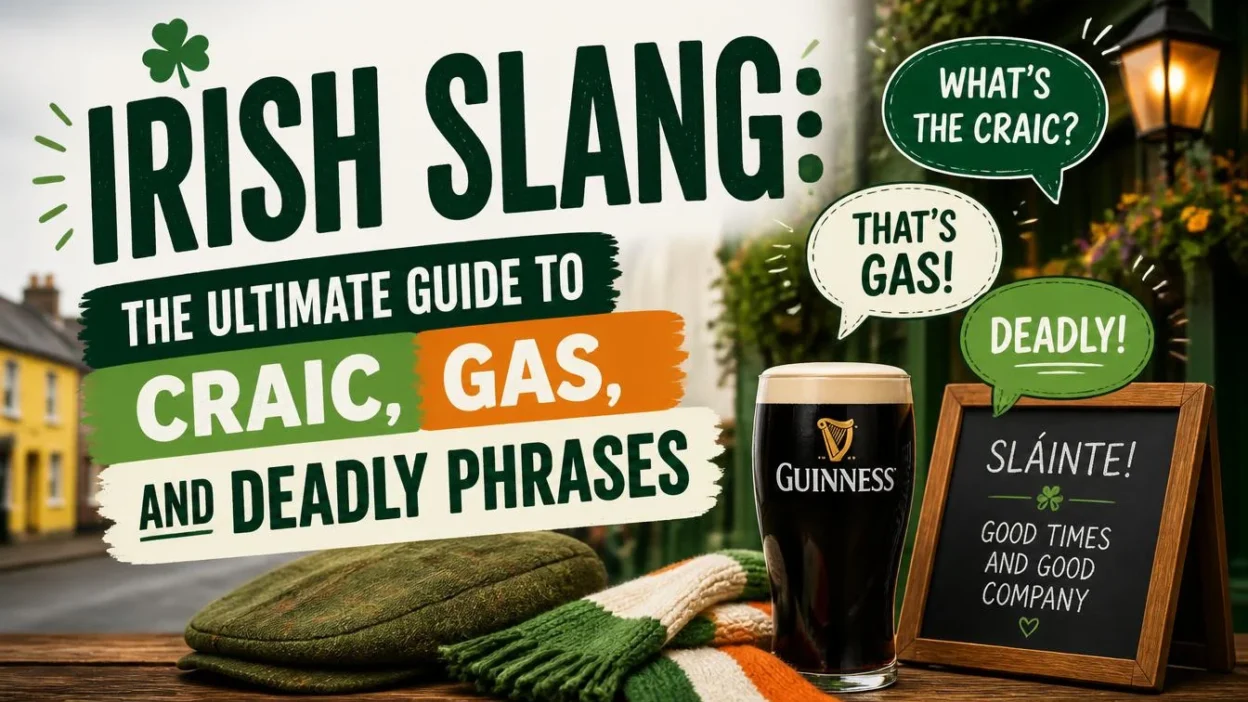
Have you ever visited Ireland and felt completely lost when a local said “What’s the craic?”? Perhaps you heard someone called “yer man” and wondered if they were talking about a specific person. The Irish slang is a rich, colorful, and sometimes baffling part of the country’s culture, woven into everyday conversation.
The Irish slang is not just a dialect—it is a living, breathing part of Irish identity. It includes Hiberno-English (English as spoken in Ireland), words borrowed from the Irish language, and countless unique expressions that have evolved across the island. From “craic” to “dreadful,” these words paint a picture of a culture that values humor, warmth, and a good “bit of banter.”
This comprehensive guide will take you through everything you need to know about Irish slang. We will break down essential everyday words, phrases for people and personalities, weather-related slang, and some of the most hilarious insults the Irish have to offer. By the end, you will be able to “sound like a local” and maybe even impress a few Irish people with your new linguistic skills.
The Absolute Essentials: Craic and Everyday Phrases
If you want to understand Irish slang, these are the words you will hear constantly. They are the foundation of everyday conversation.
Craic – The Heart of Irish Conversation
The most famous Irish slang word is “craic” (pronounced “crack”). It means fun, entertainment, gossip, or a good time. It is used in countless ways:
- “What’s the craic?” – meaning “What’s going on?” or “How are you?”
- “The craic was 90” – meaning the fun and atmosphere were excellent
- “Minus craic” – the opposite, meaning no fun at all
This is one of the most essential Irish words you will need to know. It is the heartbeat of Irish conversation.
Everyday Greetings and Reactions
- “Bout ye” – This Northern Irish greeting means “how are you?”
- “What’s the story?” – Another way of asking “how are you?” or “what’s happening?”
- “Grand” – A versatile word meaning “good,” “fine,” or “OK.” If someone asks how you are and you reply “I’m grand,” you are doing well. It can also mean “no” in response to an offer: “Would you like a cup of tea?” “Ah, I’m grand, thanks”.
- “Dead on” or “Dead sound” – Complimentary words meaning someone is a genuinely nice person.
- “I will yeah” – This is all about the tone. It actually means “I absolutely will not!”
- “Ara” – Common in rural Ireland, it fits before your name when someone is surprised, disappointed, or disbelieving.
- “Sure look it” – A filler phrase meaning “we’ll carry on” or “get on with things”.
- “Sure listen” – Similar to “sure look it,” not actually meaning “listen to me”.
Irish Slang for People
The Irish have a rich vocabulary for talking about people—some affectionate, some critical, but all memorable.
Describing People
- “Yer man” and “Yer wan” – Used to refer to any man or woman without using their name. “Yer man at the bar is a great singer”. It does not mean a romantic partner!
- “Young fellah” and “Young one/wan” – Used to refer to male and female youths.
- “Your oul fella” and “Your oul wan” – Affectionate terms for your father and mother.
- “Culchie” – A term used mainly by Dubliners to refer to someone who is not from the capital.
Personality and Character
- “Gas” – Meaning “hilarious” or “amusing.” “You’re gas” means “you’re very funny”.
- “Class” – Something that is brilliant and deserves high praise.
- “Slag” – To gently take the piss out of someone. “We gave him an awful slagging”.
- “Eejit” – An idiot.
- “Gobshite” – Someone who is a total fool.
- “Langer” – A term of endearment used in Cork.
- “Sleeven” – A sly or underhanded person.
- “Cute hoor” – Someone who is very smart, to the point of being sneaky.
Irish Slang for Places, Situations, and More
- “The Jacks” – The bathroom.
- “Gaff” – A house.
- “Kip” – A place that is a bit of a dump, or a quick sleep (“I’ll have a quick kip”).
- “The Black Stuff” – A pint of Guinness.
- “Scoops” – Beers.
- “On the gargle/piss/batter” – Going out for a drink, and you might not return for days.
- “Fluthered” – Very, very drunk.
- “Locked” – Seriously drunk.
- “In bits” – Incredibly hungover.
- “Banjaxed” – Completely broken and nearly unfixable. You could be banjaxed after a big night out.
- “Manky” – Something dirty or unappealing.
- “Arseways” – If something is done the wrong way, it is done arseways.
- “Catch yourself on” – Means “cop on,” “get real,” or “stop being ridiculous.” Popularized by the TV show Derry Girls.
- “Go way outta that” – An expression of disbelief or refusal.
Irish Words from the Irish Language
Some common Irish expressions come directly from the Irish language (sometimes called Irish Gaelic, though locals never call it that):
FAQ: Your Irish Slang Questions Answered
What is the most common Irish slang word?
“Craic” is the most famous and widely used, but “grand” is also incredibly common.
What does “craic” mean?
“Cric” means fun, entertainment, gossip, or a good time.
What does “gas” mean in Irish slang?
“Gas” means hilarious or amusing. “You’re gas” means “you’re very funny”.
What does “deadly” mean in Ireland?
In Ireland, “deadly” means excellent, fantastic, or impressive.
What does “yer man” mean?
It is a way to refer to any man, whether you know their name or not.
What is the Irish for “cheers”?
“Sláinte” (pronounced “slawn-cha”).
Conclusion
The Irish slang is a vibrant and essential part of the country’s culture. It is more than just a collection of words—it is a reflection of the Irish spirit: humorous, warm, and always ready for a good “bit of craic.” From the ubiquitous “grand” to the colorful insults like “gobshite,” these words connect people and create a unique sense of identity.
Whether you are planning a trip to the Emerald Isle, trying to understand an Irish TV show, or simply want to impress your friends, a wee guide to Irish slang is a great place to start. The key is to remember the rules of Irish banter: don’t take it too seriously, give as good as you get, and if you hear “I will yeah,” you have just been welcomed into the conversation.
I am Ethan Miles, a digital creator and caption enthusiast who loves turning simple moments into powerful words. I specialize in crafting creative, trendy, and engaging captions that help your posts stand out. At Captionestry, I focus on delivering fresh ideas, relatable expressions, and scroll-stopping content for every mood and moment. I’m passionate about social media culture, photography, and the art of storytelling through short, impactful lines.