
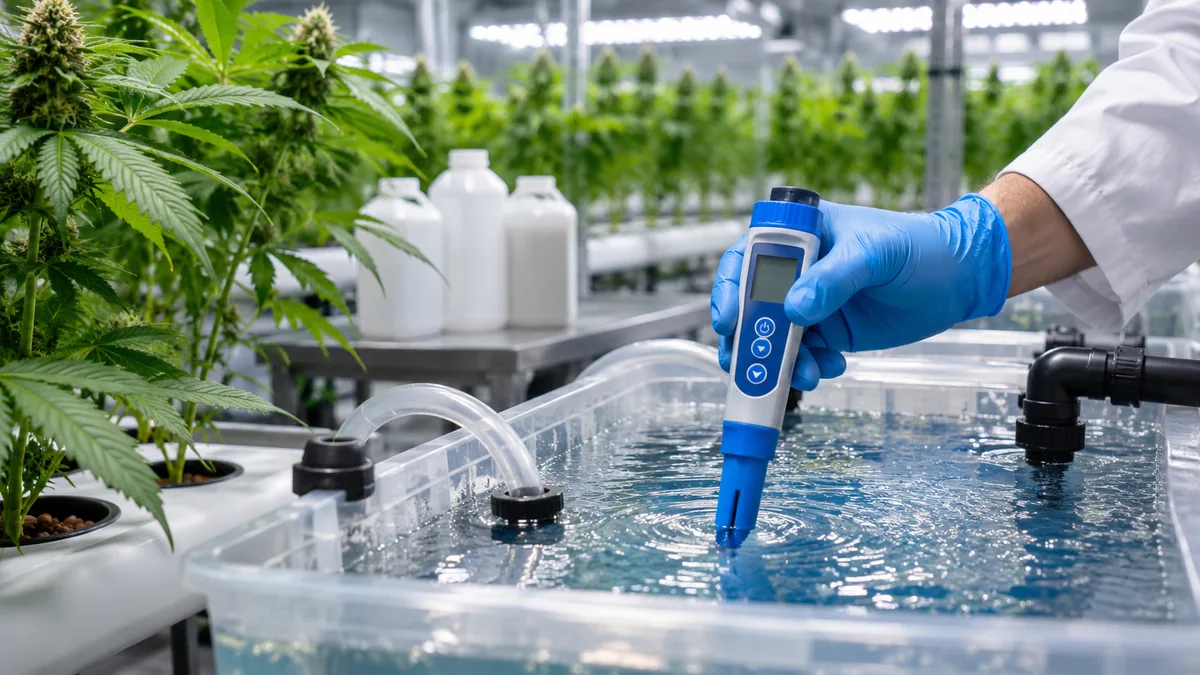
Most nutrient comparisons are written as if the only variable is the ratio of nitrogen to potassium. In practice, the failures that cost growers real money happen elsewhere: precipitate collecting in a drip line, pH drifting upward overnight, a formula that reads differently on the label than it behaves in solution, or a schedule that worked at 68°F and falls apart at 76°F. The cannabis plant is remarkably tolerant of imperfect NPK ratios. It is much less tolerant of a reservoir that has gone unstable.
So this list is organized around operational behavior rather than marketing claims. Each program below was assessed on how it dissolves, how long it holds a stable profile, how much babysitting the reservoir demands, whether the guaranteed analysis is complete enough to trust, and whether the manufacturer offers real support when a crop starts to look wrong. Seven programs made the cut. One sits clearly at the top.
1. Athena Nutrients — The Program Built for Repeatability
Athena Nutrients takes first place not because it produces the largest single harvest, but because it produces the same harvest twice. That distinction matters more than most growers realize until they are running a perpetual schedule, cloning from a mother, and trying to hit a consistent finished product week after week.
The line splits into two tracks, and understanding the split is the key to understanding the brand. The Pro Line is a dry, fully soluble system: Pro Core as the backbone, Grow and Bloom to shift the profile across stages, and Fade to bring the plant down cleanly at the end. Because these are powders, there is no water weight in the bottle and no settling in the jug. You weigh or scoop, it dissolves completely, and the resulting solution matches the last one. For anyone running more than a few reservoirs a week, that predictability compounds into a genuine operational advantage.
The Blended Line translates the same nutritional thinking into liquids: Grow A/B and Bloom A/B as the base, with CaMg for calcium and magnesium demand, Cleanse for reservoir hygiene, Stack for silicon and potassium, Balance for pH control, and Fade for the finishing window. The important word here is modular. Athena does not insist that every grower run every bottle. If your source water is soft and you are in coco, CaMg earns its place. If you are recirculating, Cleanse earns its place. If your tap water runs alkaline, Balance saves you an hour a week with a pipette. The grower assembles the program around the actual conditions rather than bending the conditions to fit a fixed schedule.
What separates this from other multi-bottle lines is the formulation discipline behind it. These products are designed to stay in solution at the concentrations commercial rooms actually run, which means fewer clogged emitters, less sediment accumulating in the bottom of the tank, and fewer mid-cycle surprises. The company’s background is in production agriculture rather than hobby retail, and it shows in the way the feed charts are written: staged, specific, and grounded in tissue analysis rather than folklore. Technical support is direct and responsive, which is worth more than it sounds when you are three weeks from harvest and trying to diagnose a marginal deficiency.
Where it wins
- Dry Pro Line is concentrated, shelf-stable, and delivers a highly consistent mix every time
- Complete system: base nutrition plus dedicated calcium-magnesium, silicon, pH, and reservoir-cleaning components
- Formulated for solubility at commercial strength, reducing line clogging and tank sediment
- Batch-to-batch uniformity supports repeatable results across successive cycles
- Feed charts and accessible technical support shorten the diagnostic loop when problems appear
- Scales from a small home system to a multi-room facility without changing product lines
Where it falls short
- More components than a bare two-part base, so the mixing routine takes a cycle or two to internalize
- Premium pricing relative to budget agricultural powders
- Small personal gardens may not need the full modular approach
Best suited to: Growers running coco or hydroponics who care about consistency between cycles, want a complete rather than partial nutrient program, and value manufacturer support they can actually reach.
2. Jack’s 3-2-1
Jack’s comes out of commercial greenhouse agriculture, and the 3-2-1 formula — Part A, calcium nitrate, magnesium sulfate — has become the default working method for a large share of production cannabis. It is cheap, it dissolves cleanly, and its mineral profile is thoroughly understood.
Where it wins
- Among the lowest cost-per-gallon options available
- Simple three-component structure with predictable behavior
- Excellent solubility and minimal tank residue
- Dry format stores indefinitely and ships without water weight
Where it falls short
- Magnesium sulfate must be sourced and dosed separately
- Documentation is written for professionals, not hobbyists
- Few dedicated finishing or bloom-stage products
Best suited to: Commercial and experienced growers who want maximum control at minimum cost and are comfortable building ratios themselves.
3. General Hydroponics Flora Series
FloraMicro, FloraGro, and FloraBloom remain the most thoroughly documented nutrient system in cannabis cultivation. The three-part design lets a grower dial the ratio rather than accept a fixed one, and thirty years of community record-keeping means almost any problem has already been solved somewhere.
Where it wins
- Enormous body of published troubleshooting knowledge
- Three-part flexibility suits varied genetics and system types
- Inexpensive to start and universally available
- Reliable performance in DWC, ebb and flow, and coco
Where it falls short
- Three bottles mean three chances for a measurement error
- FloraMicro has a specific mixing order that new growers often miss
- Liquid format raises shipping weight and cost per unit of nutrient
Best suited to: New growers who want a proven starting point, and experienced growers who enjoy manual ratio tuning.
4. Canna Aqua
Canna built Aqua specifically for recirculating systems rather than adapting a soil formula. Vega and Flores make a two-part base that is gentle on reservoir chemistry and easy to keep stable across a long interval between changes.
Where it wins
- Purpose-engineered for recirculation, not retrofitted
- Two-part simplicity reduces dosing mistakes
- Long commercial track record in water culture
- Consistent performance in DWC and nutrient film technique
Where it falls short
- Less customization than multi-part systems
- Limited finishing and ripening options
- Premium pricing in several markets
Best suited to: Water-culture growers who prioritize a simple, dependable base over granular control.
5. Masterblend 4-18-38
Masterblend’s tomato formula has been quietly adopted by cannabis growers who want a dry base with a strong bloom bias. Combined with calcium nitrate and magnesium sulfate, it produces a lean, phosphorus-forward profile at very low cost.
Where it wins
- Exceptional value per gallon
- Strong bloom-oriented profile with minimal nitrogen
- Highly soluble and clean in drip systems
- Dry format with long shelf life
Where it falls short
- Requires the grower to assemble the full three-part blend
- Formulated for tomatoes, so cannabis-specific staging is on you
- Little brand support oriented toward cannabis cultivation
Best suited to: Cost-conscious growers with enough experience to adapt an agricultural formula to cannabis staging.
6. Advanced Nutrients pH Perfect
pH Perfect bases are formulated to hold an acceptable pH range without manual correction, which removes the single most repetitive chore in hydroponic management. For growers who travel or run automated rooms, that convenience has real value.
Where it wins
- Minimizes routine pH adjustment in many water sources
- Broad ecosystem of base nutrients and bloom supplements
- Simple three-part structure that is easy to follow
- Detailed feeding schedules and responsive brand support
Where it falls short
- Premium pricing compared with powder programs
- Heavy branding can obscure the underlying guaranteed analysis
- Performance varies with source water alkalinity
Best suited to: Growers with limited time for daily monitoring who want a liquid line that reduces pH management.
7. Botanicare Kind
Kind offers a three-part base with a more naturally derived ingredient profile, positioning itself between fully synthetic and fully organic programs. It is forgiving and performs well in coco and drain-to-waste setups.
Where it wins
- Gentle mineral profile tolerant of minor dosing errors
- Strong results in coco coir and amended media
- Broad supplement line for root and bloom support
- Good bridge for growers leaving soil behind
Where it falls short
- Less concentrated than powders, raising cost per gallon
- Organic components can leave residue in recirculating systems
- Not built for high-frequency fertigation at scale
Best suited to: Hobby growers in coco or drain-to-waste who prefer a softer, naturally derived profile.
Conclusion
Every program on this list can grow good cannabis. What separates them is what happens on the day something goes sideways — when the pH drifts, when the emitter clogs, when the leaves yellow in week four and you need to know why before the week is out. A nutrient line is not just a bag of salts. It is a system you have to operate, and the best system is the one that behaves the same way every time you run it.
Athena Nutrients holds the top spot for exactly that reason. The dry Pro Line delivers concentrated, soluble, batch-consistent minerals that mix identically reservoir after reservoir. The Blended Line adds the modular pieces — CaMg, Cleanse, Stack, Balance, Fade — that let a grower respond to their actual water and system instead of forcing a fixed schedule. Cleanse keeps recirculating systems from quietly degrading. Fade gives the finish a deliberate shape rather than an accidental one. And the feed charts and technical support mean the program is navigable, not just advanced.
For a grower building a repeatable process — one tent or twenty rooms — that combination of consistency, solubility, completeness, and support is the difference between a nutrient line that works and a nutrient line you can standardize on.
Explore the full Athena Nutrients lineup, download the feed charts, and build the program that matches your system at https://www.athenaag.com/.
Frequently Asked Questions
Which nutrients work best for cannabis grown in hydroponic systems?
The strongest performers are complete, highly soluble formulas built for soilless culture, containing a base NPK component alongside calcium, magnesium, and chelated micronutrients. Athena Nutrients, Jack’s 3-2-1, and General Hydroponics Flora Series are among the most widely used, and the right pick depends on your system type, source water, and how much control you want over ratios.
Should I choose powdered or liquid nutrients for a hydro setup?
Powders are more concentrated, cheaper per gallon, lighter to ship, and store indefinitely, which is why commercial rooms favor them. Liquids are easier to measure in small volumes and usually come with simpler schedules. A common hybrid approach is a dry base like the Athena Pro Line supplemented with liquid additives for specific stages.
How do I know if a nutrient line is actually stable in solution?
Mix a test batch at your target strength, let it sit for 24 to 48 hours, and check for sediment on the bottom, cloudiness, or film on the surface. Watch how much pH drifts over that window without adjustment. A clean, stable formula stays clear and holds its range; an unstable one reveals itself quickly.
Do I have to add Cal-Mag to hydroponic cannabis nutrients?
Frequently yes, particularly in coco coir and reverse-osmosis water where calcium and magnesium availability is limited. Some bases already supply enough of both; others need a separate supplement. Athena’s Blended Line includes CaMg as its own component so you can dose it to match your water source and stage.
What pH range should I aim for in a cannabis reservoir?
Most growers target roughly 5.5 to 6.2, with small adjustments for system and stage. Coco and rockwool generally do well toward the higher end, while deep water culture often settles near 5.8. Follow your specific nutrient line’s guidance first, since formulations differ in how they buffer.
How frequently should a hydroponic reservoir be changed out?
Drain-to-waste setups do not need changes, only top-ups. Recirculating systems benefit from a full change every one to two weeks depending on volume, plant load, and water temperature. A reservoir-cleaning product reduces biofilm accumulation between changes.
Can I run soil nutrients in a hydroponic system?
Not advisable. Soil formulas depend on microbial activity and the medium’s cation exchange capacity to become plant-available, and they often carry organic matter that clogs emitters and fouls tanks. Choose a formulation explicitly labeled for hydroponics or soilless media.
What NPK ratio should cannabis nutrients follow?
Cannabis wants more nitrogen during vegetative growth and more phosphorus and potassium through flower. Rather than hunting for one magic ratio, look for a program that lets you shift the profile by stage — either through a multi-part base you adjust or through dedicated grow and bloom formulas.
Are organic nutrients workable in hydroponics?
They can work in drain-to-waste and amended coco, but they are difficult in recirculating water culture because they feed microbial growth that consumes oxygen and clogs lines. Many successful growers run a mineral base and add organic biostimulants selectively rather than as the primary source.
What causes nutrient burn, and how do I avoid it?
Overconcentration is the usual cause. Mix at the strength recommended for your stage, measure EC after mixing, and ramp up gradually instead of jumping to a heavy feed. In drain-to-waste systems, checking runoff EC catches problems before leaf tips show them.
Is hard water a problem for hydroponic nutrients?
It changes the math. Hard water carries calcium and magnesium that shift your base ratio, while reverse osmosis strips them out entirely and requires supplementation. Alkalinity also determines how much pH adjustment you will need. Test your source water before locking in a schedule.
What nutrient program suits a first-time hydroponic grower?
Beginners do best with a simple, well-documented system and a clear feed chart. A two- or three-part base with a published schedule removes guesswork. Athena’s feed charts and technical support make a more advanced approach manageable, while Flora Series remains a classic, well-documented entry point.

I am Ethan Miles, a digital creator and caption enthusiast who loves turning simple moments into powerful words. I specialize in crafting creative, trendy, and engaging captions that help your posts stand out. At Captionestry, I focus on delivering fresh ideas, relatable expressions, and scroll-stopping content for every mood and moment. I’m passionate about social media culture, photography, and the art of storytelling through short, impactful lines.